

When a Successful Campaign Produces an Unfinished Conversation
A shopper in Pune sees an Instagram promotion for a new appliance, opens the retailer’s website, compares two models, asks a question on WhatsApp, and then visits a nearby store. The campaign has worked, but the sale is still uncertain. The store associate cannot see the WhatsApp exchange, the digital team counts a click as success, and nobody follows up after the visit. This is the central retail marketing problem in an omnichannel market: attention moves quickly, while context often stops at the boundary between teams and systems.
Effective retail marketing connects discovery, conversation, purchase, and follow-up as one customer journey. It gives teams enough shared context to answer the next question without making the shopper repeat the last one. In India, where shoppers routinely move among marketplaces, brand sites, social platforms, messaging apps, phone calls, and stores, retail marketing must coordinate both communication and ownership. A strong retail marketing strategy therefore does more than publish promotions. It identifies intent, records consent, routes enquiries, and measures whether a campaign ultimately helped a shopper make a confident decision.
See how Callveriq connects conversations.
What Retail Marketing Means Today
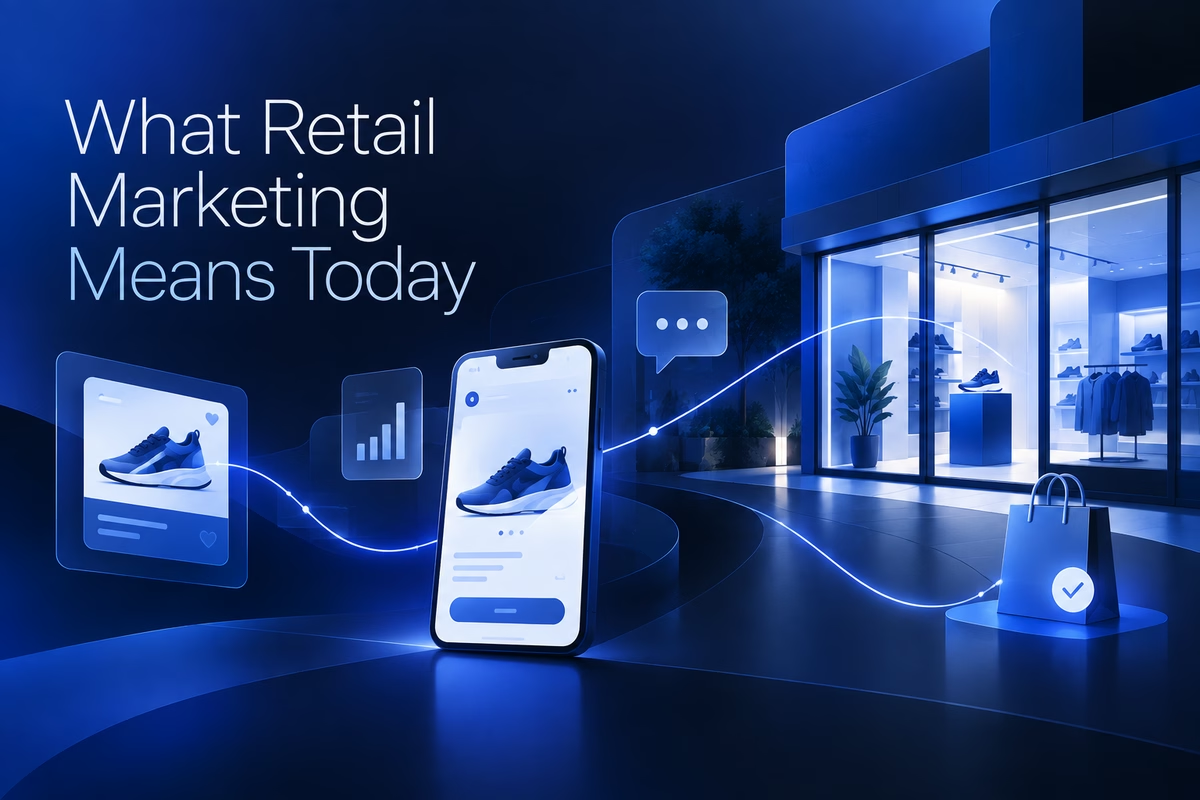
Retail marketing is the process of attracting shoppers, helping them evaluate products, converting demand, and building repeat purchase behaviour. Traditional retail marketing concentrated on the four Ps: product, price, place, and promotion. Modern retail marketing retains those fundamentals but adds customer data, conversational channels, fulfilment choices, loyalty signals, and post-purchase service.
This distinction matters because a retail marketing campaign and a retail marketing system are not the same thing. A campaign has a message, audience, channel, offer, and time window. A retail marketing system connects that campaign to inventory, customer profiles, conversations, sales workflows, and measurement. Campaigns create moments; systems preserve continuity between those moments.
The 2025 retail environment also rewards relevance over sheer message volume. McKinsey’s research on European retail found that more than 70 percent of surveyed CEOs believed a seamless omnichannel shopping experience would be foundational to success by 2030. Although the study is European, the operating lesson is relevant to retail marketing in India: channel expansion without channel coordination creates more hand-offs, not necessarily a better experience.
A practical retail marketing strategy aligns four layers:
| Layer | Question retail teams must answer | Typical evidence |
|---|---|---|
| Demand | What prompted interest? | Campaign, keyword, creative, audience |
| Conversation | What does the shopper need? | Intent, questions, sentiment, language |
| Commerce | What could complete the purchase? | Product, price, stock, store, payment |
| Continuity | What should happen next? | Owner, follow-up time, channel, outcome |
When these layers share data, retail marketing becomes easier to measure and less frustrating for shoppers. When they remain separate, omnichannel retail marketing becomes a collection of disconnected tools.
Explore connected journeys with Callveriq.
How Retail Marketing Connects Campaigns With Shopper Conversations
The connection begins with identity and intent. A shopper may arrive from a paid search ad, QR code, influencer post, marketplace listing, or store display. Retail marketing should capture the source without allowing the source to define the entire journey. The useful question is not merely “Which ad was clicked?” but “What is the shopper trying to accomplish now?”
Retail marketing automation can attach campaign information to the enquiry, recognize a returning shopper where permission exists, and route the conversation according to product, location, language, or urgency. The conversation may then continue through WhatsApp, voice, SMS, web chat, email, or a store associate. Omnichannel retail marketing works when every channel uses the same current context rather than launching an independent script.
Salesforce’s holiday-shopping analysis reported that AI-supported discovery and service influenced a substantial share of online orders, while mobile devices remained central to purchase behaviour. The broader retail marketing lesson is that assisted discovery is moving closer to the transaction. Retailers should treat chat, recommendation, and follow-up interactions as measurable parts of commerce, not as peripheral support activity.
Retail marketing campaigns should therefore pass a small, usable context package into each conversation: campaign source, product viewed, offer eligibility, preferred language, location, consent state, and recent actions. Too little context forces repetition. Too much unstructured data slows the associate. Good retail marketing surfaces the next useful fact.
Connect every enquiry through Callveriq.
This blog is just the start.
Unlock the power of Callveriq’s AI with a live demo.

How Should Indian Retailers Connect Marketing Campaigns With Sales Follow Up
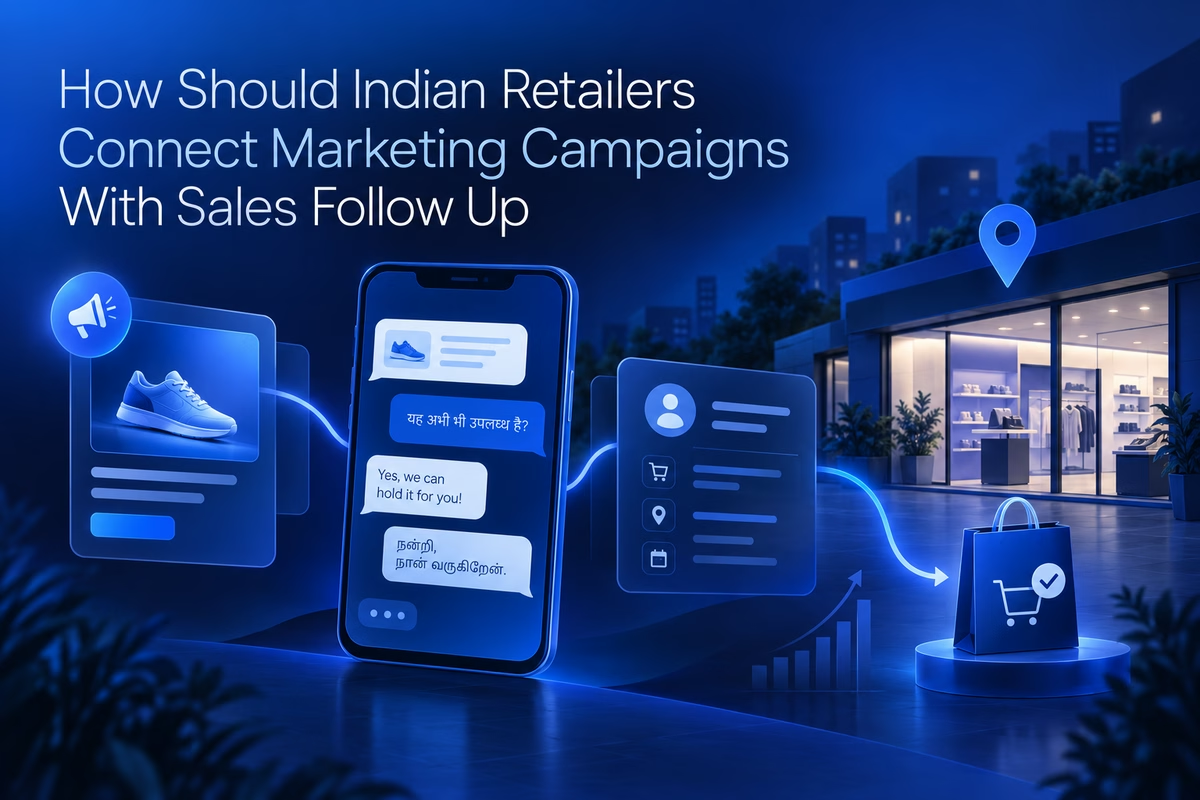
Indian retailers should connect retail marketing campaigns with sales follow-up through a shared lead record, explicit routing rules, channel-aware consent, and a measurable next action. The aim is not to contact every visitor. It is to respond appropriately when behaviour signals a genuine need: a product question, abandoned high-value cart, store-availability request, demo request, financing enquiry, or unresolved delivery concern.
The workflow should begin when retail marketing generates an identifiable enquiry. The system records source and intent, checks consent, removes duplicates, and assigns an owner. A serviceable enquiry can go to a store, inside-sales team, franchise, category specialist, or automated assistant. The retail marketing automation layer should also set a response window and stop conditions so shoppers are not contacted after purchase, opt-out, resolution, or repeated non-response.
| Journey signal | Appropriate follow-up | Avoid |
|---|---|---|
| Product comparison | Answer differences; offer availability help | Immediate discount pressure |
| Cart abandonment | Resolve price, payment, delivery, or trust concern | Repeating the same coupon daily |
| Store availability query | Confirm stock and reserve where possible | Sending the shopper to an unverified store |
| High-consideration enquiry | Schedule a knowledgeable callback | Generic bulk calling |
| Completed purchase | Share fulfilment and care information | Continuing acquisition messages |
India’s linguistic and geographic diversity makes orchestration especially important. Retail marketing follow-up may need Hinglish or a regional language, local store timings, pin-code serviceability, cash-on-delivery information, or financing details. A national retail marketing strategy can define policy, while local teams supply the context that makes the conversation useful.
KPMG’s 2025 discussion of India’s digital economy highlights the scale of digital transformation and the need to translate growth into trusted operating models. For retail marketing, that means collecting only needed data, explaining its use, and maintaining controls across partners and platforms.
Coordinate retail follow-up with Callveriq.
Benefits and Use Cases of Connected Retail Marketing
Connected retail marketing improves more than conversion attribution. It reduces duplicated outreach, shortens response time, gives associates a clearer next action, and helps managers distinguish campaign weakness from follow-up weakness. Retail marketing teams can learn whether shoppers ignored an offer, encountered an inventory issue, needed more information, or received no response.
Common retail marketing use cases include new-product launches, festive campaigns, loyalty reactivation, store-event promotion, abandoned-cart recovery, replenishment reminders, warranty renewal, financing assistance, and post-purchase education. The same retail marketing strategy can support each use case, but the timing and tone should change.
For example, a festive retail marketing campaign may generate a sharp enquiry spike. Retail marketing automation can classify intent and handle routine availability questions while escalating high-value or complex conversations. A loyalty retail marketing campaign may instead prioritize purchase history, replenishment timing, and preference. The technology is similar; the customer's purpose is different.
Gartner’s 2026 CMO coverage describes a “growth-with-less” environment and reports that CMOs are allocating a meaningful budget to AI while many remain unprepared to scale it. The implication for retail marketing is practical: automation should be tied to an operating outcome, clear ownership, and quality controls, not deployed simply because a channel supports it.
Retail marketing performance improves when teams track journey metrics alongside channel metrics. Useful measures include enquiry-to-conversation rate, qualified-intent rate, first-response time, follow-up completion, assisted conversion, opt-out rate, repeat-contact rate, and revenue by resolved intent. This view makes retail marketing accountable for continuity rather than clicks alone.
Measure shopper conversations through Callveriq.
Challenges and Practical Safeguards
The first challenge is fragmented data. Retail marketing data may sit across ad platforms, a customer data platform, CRM, commerce engine, marketplace, messaging tools, and point-of-sale systems. A retailer does not need to merge every field before improving retail marketing. It needs a small shared record and reliable event definitions.
The second challenge is over-automation. Retail marketing automation can scale irrelevant contact as easily as helpful contact. Retailers should define contact frequency, quiet hours, escalation conditions, consent rules, language preferences, and suppression events. Human review remains important for complaints, vulnerable customers, high-value exceptions, and conversations involving policy judgement.
The third challenge is attribution. Last-click reporting can over-credit the final channel and hide the contribution of store visits, conversations, or earlier discovery. Retail marketing teams should use assisted-conversion reporting and controlled experiments where possible. The purpose is not to assign perfect credit; it is to make better allocation decisions.
The fourth challenge is organisational ownership. Marketing may generate the lead, sales may own the follow-up, stores may own inventory, and service may inherit the issue. Retail marketing needs a written responsibility model covering who responds, when ownership transfers, what counts as resolution, and which event stops outreach.
Build governed journeys using Callveriq.
Turning Campaign Attention Into Customer Continuity
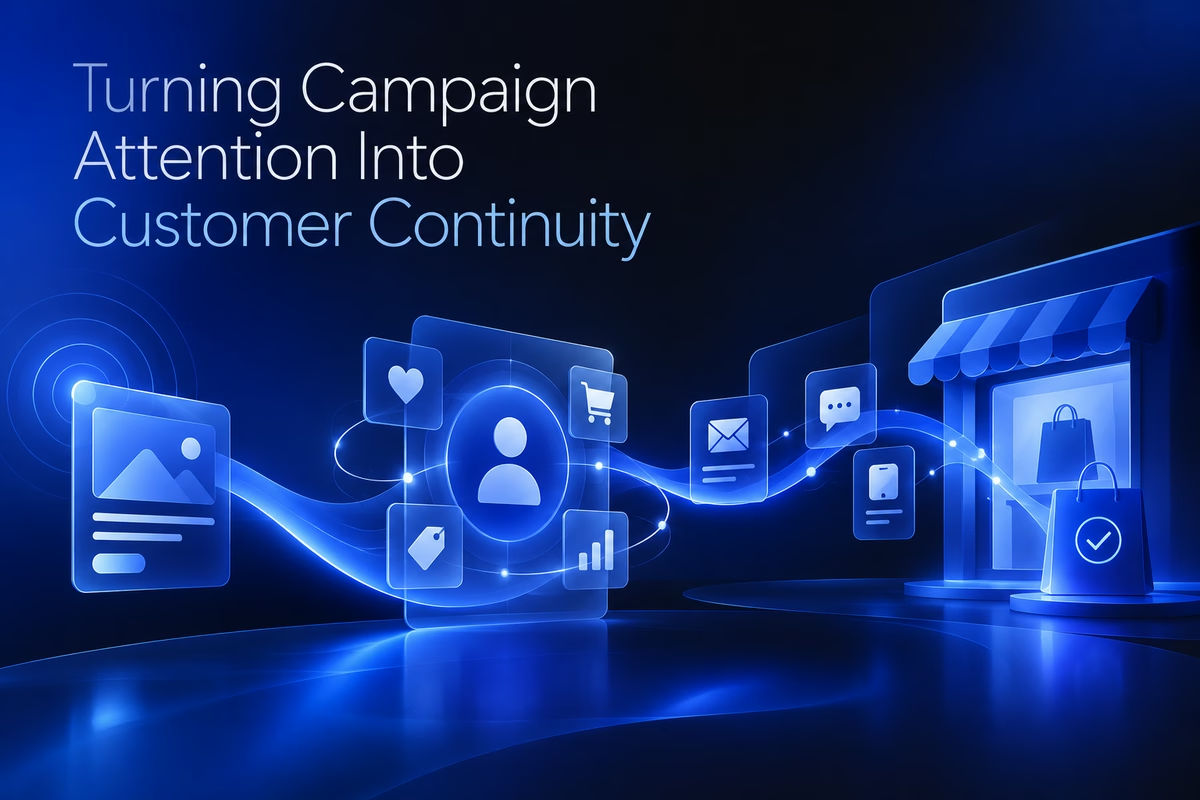
The real test of retail marketing is not whether a campaign earns attention; it is whether the retailer can carry that attention into a useful conversation and a responsible next step. Indian retailers that connect campaign source, shopper intent, consent, inventory, store context, and follow-up ownership can reduce abandoned journeys without increasing message fatigue. Retail marketing automation strengthens this model when it preserves context and supports people instead of replacing judgement. The takeaway is clear: measure completed conversations and resolved shopper needs alongside clicks and reach. That is how retail marketing becomes a dependable bridge between campaign investment, customer confidence, and revenue. Callveriq can help retailers build that bridge across voice, WhatsApp, and other customer touchpoints.
Connect retail journeys with Callveriq.
FAQs
1. How is retail marketing different from brand marketing?
Retail marketing is closer to product discovery, purchase, store traffic, and repeat buying. Brand marketing shapes longer-term awareness and preference. Most retailers need both, but retail marketing usually carries more immediate commercial and operational signals.
2. Can small retailers use retail marketing automation?
Yes. Small retailers can begin with consented customer records, simple enquiry categories, response templates, and clear follow-up ownership. Retail marketing automation should remove repetitive coordination before adding complex personalization.
3. Which channels matter most for retail marketing in India?
The right mix depends on category and audience. Search, marketplaces, social media, WhatsApp, voice, SMS, email, apps, and stores can all matter. Effective retail marketing connects the channels shoppers actually use rather than maximizing channel count.
4. How often should a retailer follow up?
Frequency should reflect shopper intent, product consideration time, consent, and response. Retail marketing should stop or slow outreach after opt-out, purchase, resolution, or repeated non-response. High frequency is not a substitute for relevance.
5. What data is essential for measuring retail marketing?
At minimum, capture campaign source, enquiry time, intent, consent, owner, response time, outcome, and purchase or resolution status. This allows retail marketing teams to identify where journeys break without collecting unnecessary personal information.