

A customer clicks your ad on Instagram, asks a question on WhatsApp, misses your AI sales call, responds to an SMS reminder, and finally converts after speaking with an agent.
Most businesses celebrate the conversion. Very few know which touchpoint actually influenced it.
This is where many B2C sales and customer experience teams struggle. They invest in AI voice agents, WhatsApp automation, email campaigns, and CRMs, but end up measuring each channel in isolation. Marketing reports one number, sales reports another, and customer support has an entirely different dashboard. Without omnichannel analytics, it's impossible to understand how customers move between channels, where AI adds value, or which journeys deserve more investment.
Modern AI platforms generate millions of customer interactions every month. The companies that outperform competitors aren't necessarily the ones using more AI. They're the ones measuring the right metrics and continuously optimizing them.
Connect every AI interaction with Callveriq.
Why Traditional Channel Reporting No Longer Works
Imagine your dashboard says:
| Channel | Conversion Rate |
|---|---|
| Voice | 18% |
| 12% | |
| 4% |
It looks straightforward. But what if 70% of customers who converted through voice first interacted on WhatsApp?
Suddenly, WhatsApp isn't an underperforming channel. It's the trigger that drives voice conversions.
This is why omnichannel customer analytics has become essential. Instead of measuring channels independently, it measures customer journeys as connected experiences.
According to Salesforce's latest Connected Customer research, customers increasingly expect companies to maintain context across every interaction rather than forcing them to repeat information when switching channels.
Likewise, Gartner's 2025 CRM strategy research highlights that AI-driven customer engagement depends on unified customer data and seamless interaction orchestration rather than isolated channel automation.
What Modern Omnichannel Reporting Should Answer
Instead of asking:
- Which channel converted the most customers?
Ask:
- Which channel started the journey?
- Which channel generated the highest engagement?
- Which touchpoint accelerated conversion?
- Where do customers abandon conversations?
- How efficiently is AI handling each interaction?
These questions reveal optimization opportunities that single-channel dashboards miss.
Unify every customer journey with Callveriq.
The 10 Omnichannel Analytics Metrics That Actually Matter
Every customer interaction generates data, but not every metric helps improve business outcomes. The most effective omnichannel analytics metrics focus on how customers engage, move across channels, and ultimately convert. Instead of tracking dozens of disconnected KPIs, prioritize the metrics that reveal where AI is driving value and where your customer journey needs optimization.
1. Connect Rate
Connect rate measures how often your outreach successfully reaches customers. For AI voice agents, it refers to answered calls. For WhatsApp, it indicates successfully delivered messages, while for email, it can be measured through open rates.
A healthy connect rate helps answer whether you're reaching the right audience at the right time.
Keep an eye on:
- Percentage of successful connections across channels
- Best-performing outreach times
- Connect rates by customer segment
- Trends over time
As a general benchmark:
- AI Voice: 25–40%
- WhatsApp Delivery: 80–95%
- SMS Delivery: 90%+
- Email Open Rate: 20–35%
A declining connect rate often indicates outdated customer data, spam labeling, poor channel selection, or ineffective outreach timing.
2. Response Rate
Connecting with customers is only the first step. Response rate measures how many of those customers actively engage with your message, making it one of the most valuable customer journey analytics metrics.
High response rates typically indicate that your messaging, personalization, and timing resonate with customers.
Monitor:
- Responses by channel
- Response time after outreach
- Personalized vs. generic campaign performance
- Response trends across customer segments
Typical benchmarks include:
- WhatsApp: 35–60%
- AI Chat: 45–70%
- AI Voice: 20–40%
3. AI Containment Rate
One of the most overlooked AI performance metrics is containment rate. It measures the percentage of conversations that AI resolves without transferring customers to a human agent.
A strong containment rate reduces operating costs and improves response speed, but it should always be evaluated alongside customer satisfaction to ensure AI isn't preventing necessary escalations.
Track:
- Percentage of conversations fully resolved by AI
- Escalation reasons
- Average resolution time
- Customer satisfaction after AI-only interactions
Industry benchmarks generally fall within:
- Retail: 60–80%
- Banking: 45–65%
- Insurance: 50–70%
- Healthcare: 40–60%
A high containment rate is valuable only when customers still receive fast, accurate resolutions.
4. Customer Journey Completion Rate
Customer journeys rarely happen on a single channel. A customer may discover a product through an ad, ask questions on WhatsApp, receive a follow-up call from an AI voice agent, and complete the purchase through an agent.
Customer journey completion rate measures how many customers successfully move from the first interaction to the desired outcome, such as a purchase, booking, application completion, or support resolution.
This is one of the most important omnichannel customer analytics metrics because it shows whether your entire workflow is working, not just individual touchpoints.
Track:
- Percentage of customers completing the intended journey
- Drop-off points between channels
- Average time taken from first interaction to conversion
- Journeys with the highest conversion probability
A low journey completion rate usually indicates friction between channels, inconsistent customer context, or ineffective follow-up workflows.
5. Channel Attribution Rate
When customers interact across multiple channels, identifying which touchpoint influenced the final outcome becomes challenging.
Channel attribution rate helps businesses understand the contribution of each channel throughout the customer journey instead of giving all credit to the final interaction.
For example, a customer may discover a brand through Instagram, engage on WhatsApp, and finally convert through an AI voice call. Attribution helps identify the role each channel played in driving that conversion.
Monitor:
- First-touch channel contribution
- Mid-journey engagement influence
- Final conversion touchpoint
- Assisted conversions across channels
This metric helps B2C teams allocate budgets more effectively and identify channels that create demand, even if they don't directly generate conversions.
6. Conversion Rate Across Channels
Conversion rate remains one of the most important AI performance metrics because it connects customer interactions with business outcomes.
However, in an omnichannel environment, conversion should not be measured only by the last channel used. Teams need to analyze conversion performance across the entire customer journey.
Track:
- Conversion rate by channel
- Conversion rate by customer segment
- Conversion rate after AI interactions
- Conversion rate for assisted vs. AI-only journeys
For example:
- Voice AI may drive immediate conversions through sales calls.
- WhatsApp may create higher engagement before purchase.
- Email may support long-term nurturing.
Comparing these patterns helps teams understand the actual role of every channel.
7. Average Resolution Time
Average resolution time measures how quickly customer queries or sales conversations reach a successful outcome.
For customer experience teams, this indicates operational efficiency. For sales teams, it shows how quickly AI can move customers from inquiry to action.
Track:
- Time taken to resolve customer queries
- Time from first interaction to conversion
- Resolution time by channel
- Resolution time for AI-only vs human-assisted conversations
A lower resolution time usually indicates better automation, improved workflows, and stronger customer experiences.
However, speed should always be measured alongside quality metrics like CSAT and conversion rate to avoid optimizing only for faster interactions.
8. Customer Satisfaction Score (CSAT)
Customer satisfaction score measures how customers feel after interacting with AI agents or human teams across different channels.
A high AI resolution rate does not always mean a better customer experience. Customers may receive quick answers but still have poor experiences if responses lack accuracy or personalization.
Monitor:
- CSAT after AI conversations
- CSAT by channel
- Satisfaction differences between AI and human interactions
- Common reasons behind negative feedback
Tracking CSAT alongside AI performance metrics helps teams identify whether automation is genuinely improving customer experiences.
9. Cost Per Successful Interaction
Omnichannel AI investments should ultimately improve efficiency while maintaining customer experience quality.
Cost per successful interaction measures how much a business spends to achieve a meaningful outcome, such as a qualified lead, resolved query, completed booking, or successful sale.
Track:
- Cost per qualified lead
- Cost per conversion
- Cost per resolved interaction
- AI vs human handling costs
This metric helps leaders understand whether AI automation is creating measurable business value rather than simply increasing interaction volume.
10. Revenue Per Customer Journey
Revenue per customer journey connects every interaction across channels with the final business impact.
Instead of asking how many calls or messages AI handled, businesses can measure how much revenue each customer journey generated.
Track:
- Revenue generated after AI interactions
- Revenue by journey type
- Conversion value by channel combination
- High-performing customer paths
This metric helps sales and CX teams identify the journeys that create the highest business impact and replicate them at scale.
Turn insights into revenue with Callveriq.
This blog is just the start.
Unlock the power of Callveriq’s AI with a live demo.

How Callveriq Helps Teams Measure Omnichannel AI Performance
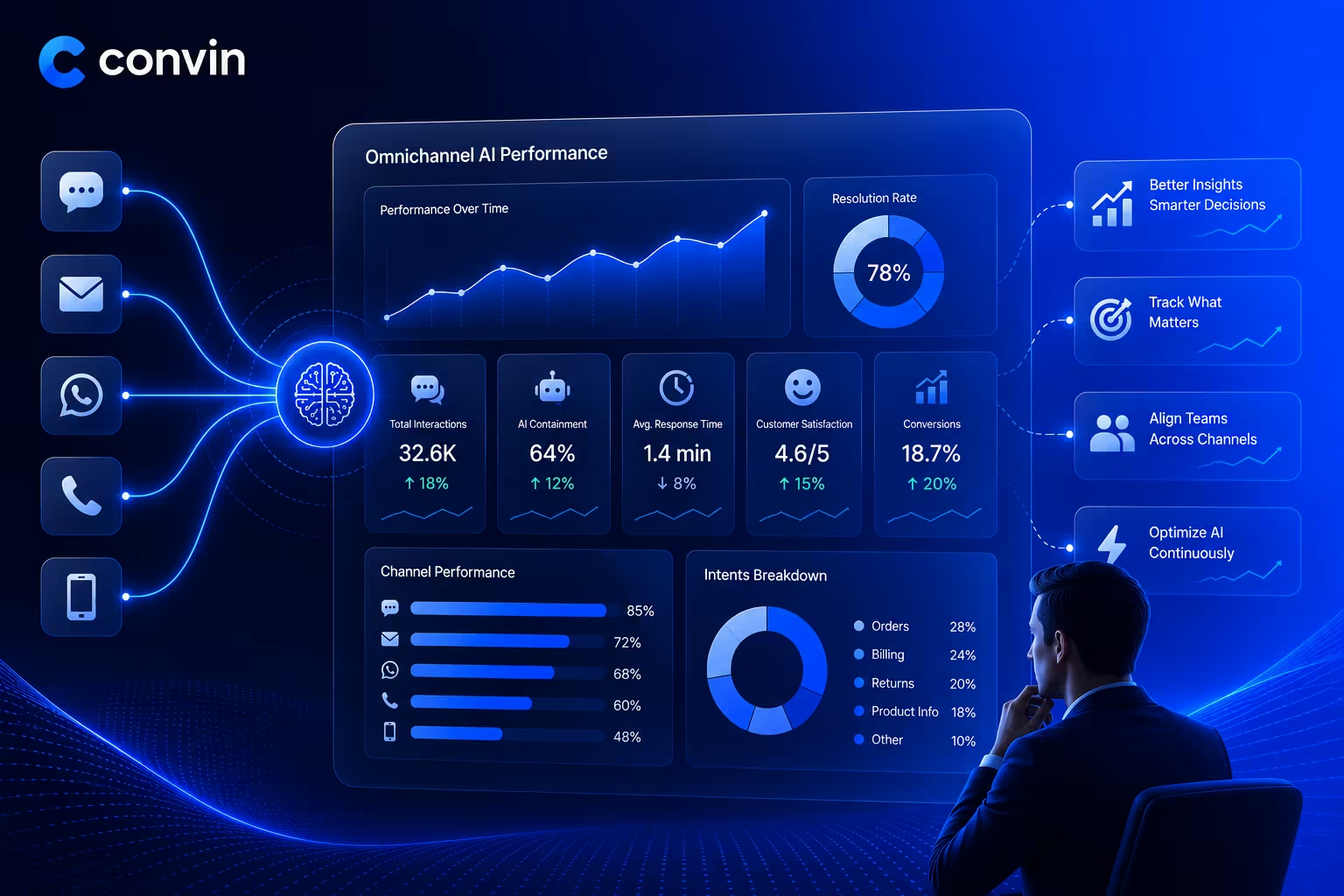
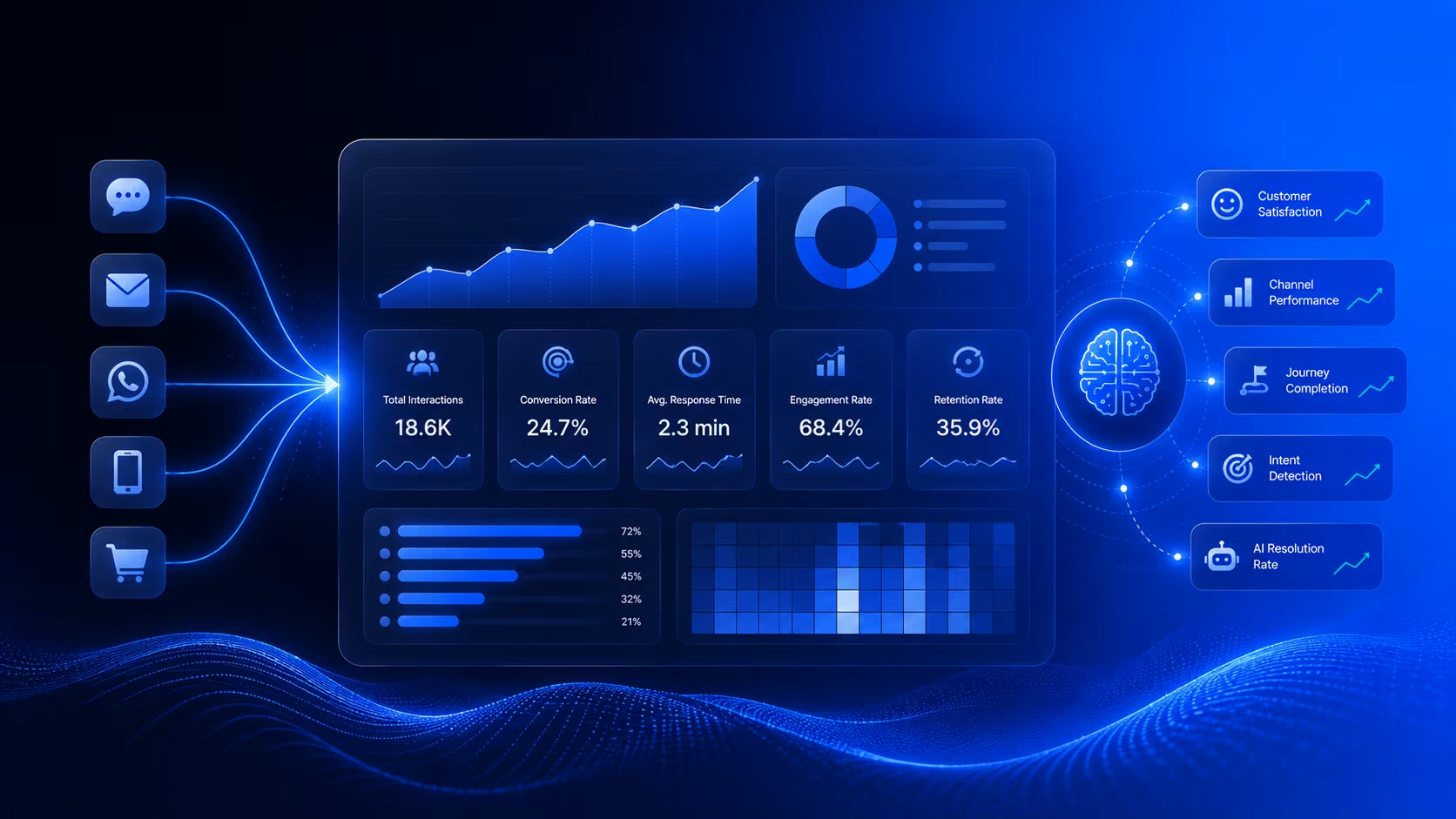
As businesses expand across voice, WhatsApp, chat, email, and CRM systems, measuring AI performance becomes increasingly complex. Callveriq brings every customer interaction into a single platform, giving sales and CX leaders complete visibility into the customer journey.
With Callveriq, teams can:
- Track customer journeys across every communication channel.
- Measure AI and agent performance from a unified dashboard.
- Analyze conversation quality alongside business outcomes.
- Monitor real-time KPIs such as connect rate, response rate, conversion rate, and CSAT.
- Identify drop-offs, optimize workflows, and continuously improve AI performance using conversation intelligence.
Instead of relying on disconnected reports, leaders gain actionable insights that improve customer experience while driving measurable business growth.
See how Callveriq optimizes omnichannel AI performance.
How to Choose the Right Omnichannel Analytics Metrics for Your Business
Not every business needs to track every metric with the same priority. The right metrics depend on your primary goal.
For B2C sales teams, focus on:
- Connect rate
- Response rate
- Channel conversion rate
- Revenue per customer journey
- Cost per successful interaction
For customer experience teams, prioritize:
- AI containment rate
- Resolution time
- CSAT
- Journey completion rate
- Escalation patterns
For AI operations teams, measure:
- AI accuracy
- Containment trends
- Conversation quality
- Workflow performance
- Channel-level engagement
The goal of omnichannel reporting is not to create more dashboards. It is to create visibility into what customers do, why they convert, and where AI can improve the experience.
Optimize AI workflows with omnichannel insights.
What This Means For Your Business
The success of an omnichannel AI strategy isn't determined by how many channels you use or how many conversations your AI handles. It's determined by whether every customer interaction contributes to better experiences and stronger business outcomes. By focusing on the right omnichannel analytics metrics, organizations can move beyond isolated channel reporting and understand the complete customer journey. Metrics such as connect rate, response rate, journey completion, AI resolution, and revenue per journey provide a far more accurate picture of performance than standalone dashboards ever could. As AI becomes central to B2C sales and customer experience, businesses that continuously measure, learn, and optimize across every touchpoint will be the ones that build lasting customer relationships and outperform competitors
FAQs
Q: What KPIs should I track to measure omnichannel AI performance for B2C sales?
Track KPIs that connect customer interactions with business outcomes, including connect rate, response rate, conversion rate, AI containment rate, customer journey completion, revenue per journey, and cost per successful interaction.
Q: How do you measure channel-wise conversion rates in an omnichannel AI platform?
Measure conversions by tracking customer journeys across every channel, including voice, WhatsApp, chat, email, and CRM interactions. Attribution models help identify which channels influence conversions instead of only measuring the final touchpoint.
Q: What is a good connect rate, conversion rate, and response rate for an omnichannel AI sales agent?
Benchmarks vary by industry and audience, but AI voice agents typically see 25–40% connect rates, 20–40% response rates, and conversion rates depend on lead quality, product type, and sales process maturity.
Q: Why are traditional channel-level dashboards insufficient for measuring AI performance?
Channel-level dashboards show individual performance but miss how customers move between channels. Omnichannel analytics connects these interactions to reveal complete customer journeys and optimization opportunities.
Q: How can AI analytics improve customer experience across multiple channels?
AI analytics identifies customer behavior patterns, detects journey drop-offs, measures conversation quality, and helps businesses optimize workflows across voice, chat, WhatsApp, and other touchpoints.