

Most B2C businesses today are technically "everywhere" - they have a website, an app, a Facebook page, a WhatsApp number, and a call center. Yet customers still complain about repeating themselves to a new agent every time they switch channels. That gap between being present on channels and being omnichannel is exactly what this guide unpacks.
For CX and sales leaders heading into 2026, getting this distinction right isn't academic. It decides whether your tech stack actually reduces churn and boosts conversion, or just adds more disconnected dashboards to your team's day. This guide answers the four questions every CX and sales leader is actually asking right now: what omnichannel really means, who's doing it right, how it differs from multichannel, and what tech stack you genuinely need to pull it off.
Discover true omnichannel strategy
What Is Omnichannel and Why Does It Matter in 2026?
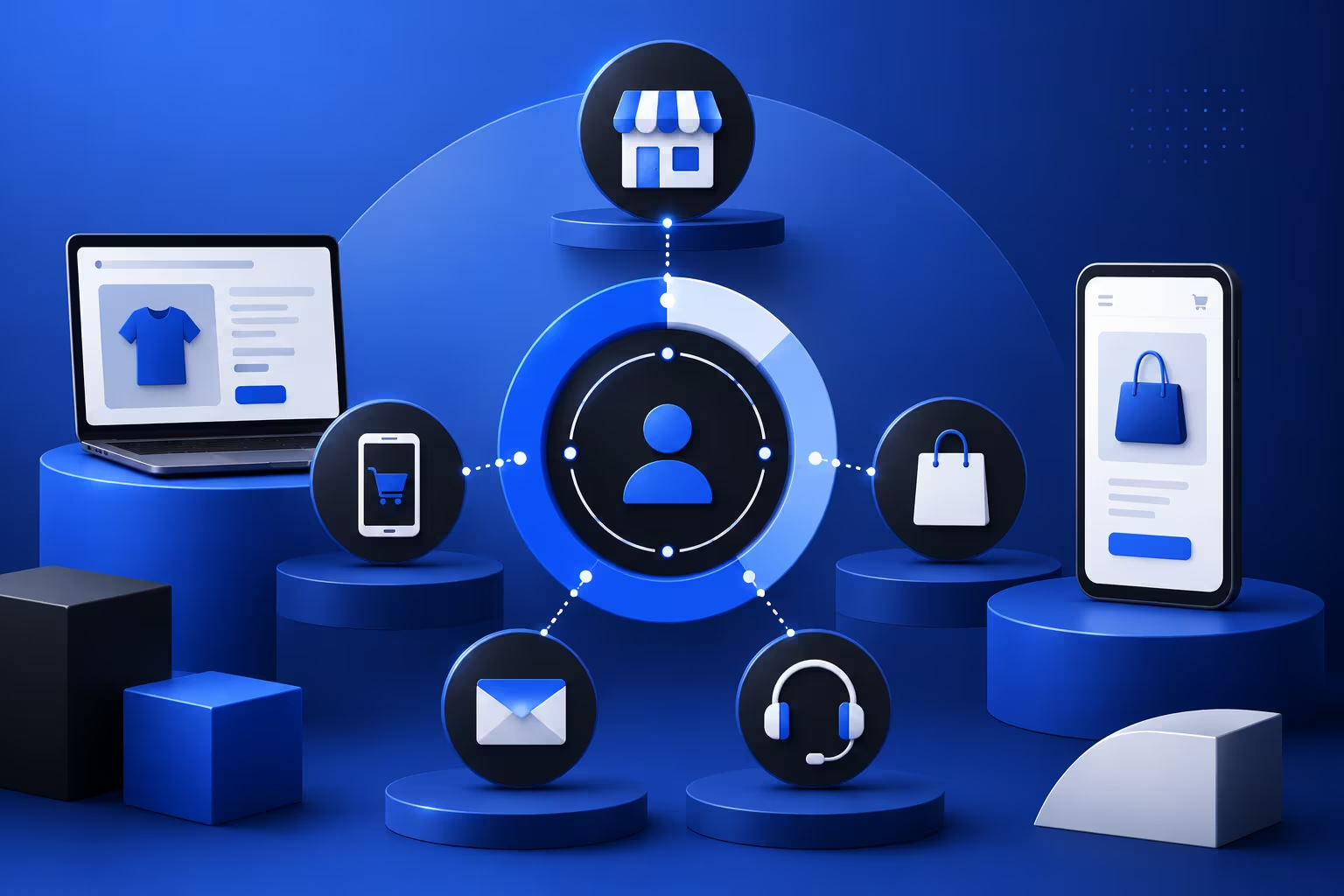
Omnichannel is a customer engagement model where every channel a customer uses ,app, website, social media, in-store, call center, chat ,is connected to one shared view of that customer's data, history, and context. The customer experience feels continuous, because the underlying systems are continuous, not because the brand happens to have more touchpoints.
This precision matters because "omnichannel" gets used loosely in marketing decks to mean "we're on a lot of platforms." That looseness has real costs. When customers engage across three or more channels, their purchasing frequency increases by 250% compared to those who interacted with just a single channel, according to MoEngage research cited in Callveriq's guide to omnichannel customer engagement. That kind of lift only shows up when channels are actually unified ,not just simultaneously available.
Why the Definition Matters More in 2026 Specifically
- Customer patience for repetition has collapsed. Shoppers expect to pick up a conversation on WhatsApp exactly where they left it on a call, with zero re-explaining.
- AI raises the bar on personalization. Once one brand uses AI to recognize a returning customer instantly, every brand that can't do the same looks outdated.
- Channel-switching mid-journey is now the norm, not the exception ,browsing on mobile, comparing on desktop, buying in-store has become standard behavior rather than a rare edge case.
- Budget scrutiny is higher. Leaders are being asked to justify every new "channel" tool, and "omnichannel" is the easiest term to misuse to justify spending that doesn't actually integrate anything.
The Practical Definition CX Leaders Should Use
If you want a definition you can actually test your own stack against, use this: a business is omnichannel only if an agent or system on Channel B can see, without asking, what happened on Channel A in the last interaction. If that's not true today, you're multichannel ,which isn't a failure, just a different (and earlier) stage.
Get the real definition right
Real-World Omnichannel Examples
A handful of brands show up again and again in omnichannel case studies because they've connected loyalty, purchase, and service data across physical and digital touchpoints in a way customers can actually feel.
1. Starbucks: Loyalty as the Connective Tissue
Starbucks Rewards exemplifies an omnichannel loyalty program that harmonizes digital and in-store experiences seamlessly, allowing members to earn and redeem "Stars" through purchases made via the mobile app, website, social media or in-store. Starbucks' mobile app powers its omnichannel strategy, with nearly 25% of transactions through mobile ordering, and the brand uses AI engine Deep Brew to analyze customer behavior and deliver personalized drink recommendations.
2. Sephora: Beauty Insider as a Single Customer Profile
Sephora sets the beauty industry's gold standard for omnichannel;since 2010, the app has unified online and offline behavior into one profile, boosting loyalty and driving cross-channel sales with personalized rewards. In-store, the Color IQ tool scans a customer's skin tone and assigns a unique ID, instantly matching shades across brands ,a detail that then follows the customer back online.
3. Disney: One Profile From Booking to Park Gate
Disney's Magic Band program connects park visitors to an immersive mobile experience, and the My Disney Experience tool allows customers to plan their trip from start to finish, then use the app in-park to locate attractions, see wait times, reserve express passes, and make purchases.
4. Amazon and Walgreens: Operational Omnichannel
Amazon has successfully blended its online and offline touchpoints into a cohesive journey over the years. On the services side, Walgreens' omnichannel strategy blends retail and healthcare into a unified ecosystem, with its mobile app letting customers refill prescriptions with real-time tracking and check local store inventory instantly.
What These Examples Have in Common
- A single loyalty or profile ID that travels with the customer across every channel
- Real-time data sync, not nightly batch updates between systems
- AI used for personalization, not just automation ,recommendations, not just routing
- A mobile app as the connective hub, even when the brand's roots are physical retail
Build connected customer experiences
This blog is just the start.
Unlock the power of Callveriq’s AI with a live demo.
How Is Omnichannel Different From Multichannel?
This is the single most misunderstood distinction in CX strategy, and it's the one that determines whether your "omnichannel investment" actually pays off.
Multichannel means a business operates on several channels ,say, phone, email, and Instagram ,but each one runs independently, often on different software, with different data, and sometimes a different team. "Multichannel" and "cross-channel" are synonyms that describe providing customers with consistent experiences across multiple channels and touchpoints, but "omnichannel" remains the widely accepted term to describe a holistic approach to customer engagement precisely because it requires that deeper integration.
Multichannel vs. Omnichannel, Side by Side
| Aspect | Multichannel | Omnichannel |
|---|---|---|
| Channel presence | Many, run separately | Many, fully connected |
| Customer data | Siloed per channel | Unified, shared in real time |
| Agent context | Starts fresh each channel | Full history visible instantly |
| Customer effort | Repeats themselves | Never repeats themselves |
| Personalization | Channel-specific, generic | Cross-channel, individual |
The Tell-Tale Signs You're Multichannel, Not Omnichannel
- A customer has to re-explain their issue when they move from chat to a phone call
- Marketing promotions don't reflect what a customer already bought in-store
- Your support team can't see a customer's app activity, and your app team can't see support tickets
- Different channels report different "single sources of truth" for the same customer
As Callveriq's guide to omnichannel experience strategies puts it, the real shift is in consolidating customer data and breaking down silos ,that's the line that separates the two models, not the number of channels on a slide.
Why This Confusion Costs Businesses Real Money
Many B2C leaders believe they're already omnichannel because procurement bought "omnichannel software." But software alone doesn't connect data that lives in separate databases with no shared customer ID. The fix isn't adding a fifth channel ,it's making the four you have talk to each other first.
Compare omnichannel vs multichannel
What Tech Enables B2C Omnichannel?
Becoming genuinely omnichannel is a technology and data architecture decision before it's a channel decision. Here's the stack that actually makes it possible.
The Core Layer: Unified Customer Data
Nothing else works without this. You need one customer record ,not five ,that every channel reads from and writes to.
- A Customer Data Platform (CDP) or well-integrated CRM as the single source of truth
- Real-time sync, not overnight batch jobs, between channel systems and that central record
- A consistent customer ID that follows the person across app, web, store, and call center
The Engagement Layer: Connected Channel Tools
- Omnichannel contact center software that unifies voice, chat, email, and social into one interface, so an agent never has to switch tools to see the full picture
- A mobile app (or equivalent) that acts as the connective hub between digital and physical, the way Starbucks and Sephora use theirs
- Marketing automation tools that pull from the same unified profile used by sales and support ,not a separate list
The Intelligence Layer: AI and Conversational Analytics
This is the layer most businesses are racing to build out in 2026, and it's also where the biggest gap between "multichannel with a chatbot" and "true omnichannel" shows up.
- Conversation intelligence that records, transcribes, and analyzes calls and chats to surface what's actually happening with customers ,this is where Callveriq's AI-backed contact center platform fits, since it unifies conversations between various platforms, ensuring that customers never feel disconnected from the brand
- Agent assist tools that give agents context mid-conversation. As Callveriq's guide on omnichannel strategies notes, this kind of agent assistance helps call center agents in real time while switching between channels while maintaining context
- Sentiment and behavior analysis to flag at-risk customers before they churn, regardless of which channel they're on
- AI-powered voice and chat automation for routine queries, freeing human agents for complex, high-stakes conversations
A Quick Checklist Before You Buy Anything
- Do all our channels write to the same customer record?
- Can an agent see a customer's last 3 interactions across any channel within 5 seconds?
- Does our AI layer learn from every channel, or just one?
- Can we measure one customer journey end-to-end, or only channel-by-channel metrics?
If most boxes are unchecked, the fix usually isn't a new channel ,it's omnichannel analytics that connects what you already have.
Build the right tech stack
To Sum Up
Omnichannel isn't a checklist of channels ,it's a data architecture decision that determines whether your customers feel known or feel like strangers every time they switch how they talk to you. The brands that get cited again and again ,Starbucks, Sephora, Disney ,didn't win by adding more channels; they won by making their existing channels share one brain. For B2C CX and sales leaders, the actionable takeaway for 2026 is simple: audit your current stack against the real definition before buying anything new, and prioritize unifying the data you already have over chasing the next channel.
Get started with Callveriq’s solution today
FAQs
1. What's the simplest way to explain omnichannel to a non-technical stakeholder? Tell them: it means a customer can start a conversation on one channel and finish it on another without ever repeating themselves, because the business sees it as one continuous conversation, not several separate ones.
2. Is omnichannel only relevant for large enterprises with big budgets? No. Even a small business can start by unifying customer data across just two channels ,like a CRM connected to both chat and phone ,before scaling further. The principle matters more than the scale.
3. How long does it typically take to become truly omnichannel? It varies widely based on how siloed your existing systems are, but most B2C businesses see meaningful progress within 3–6 months once they prioritize unifying customer data over adding new channels.
4. What's the biggest mistake businesses make when trying to "go omnichannel"? Buying a new channel tool before fixing data integration between the channels they already have ,which usually adds another silo instead of removing one.
5. How does Callveriq help businesses become omnichannel? Callveriq's AI-backed contact center platform unifies calls, chats, emails, and social interactions into one system with shared context, so agents always see the full customer history. It also uses conversation intelligence and sentiment analysis to help CX and sales teams act on omnichannel data in real time;you can see how it works in Callveriq's omnichannel contact center software guide.