

What Is RevOps?
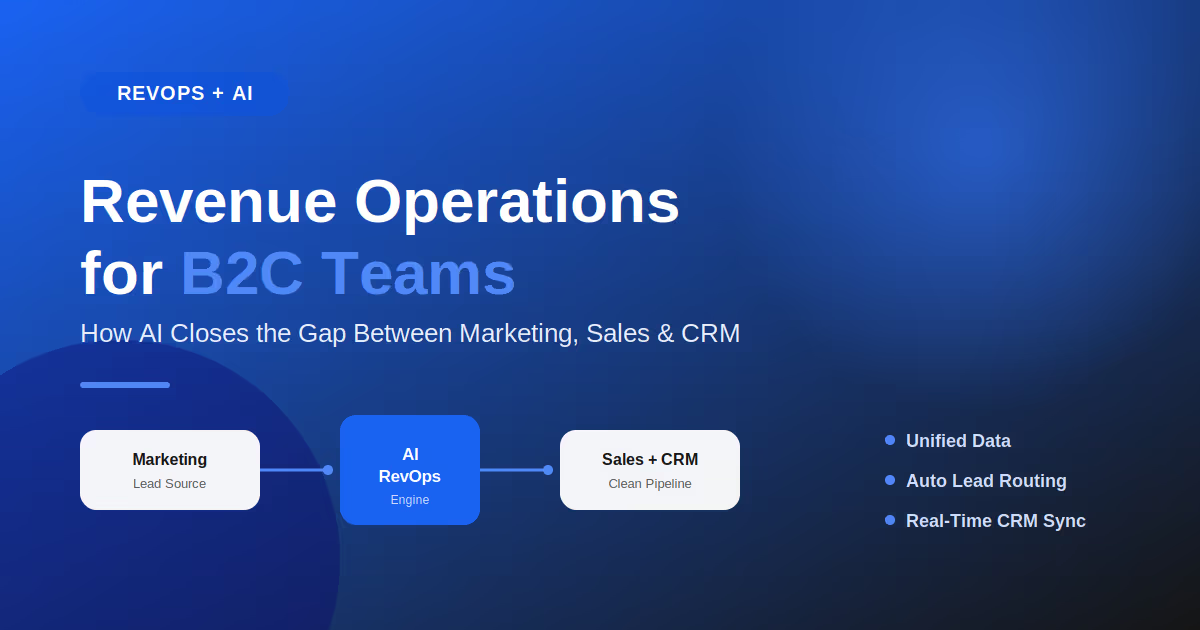
Revenue operations, or RevOps, is the function that unifies marketing, sales, and customer success around one shared source of truth — usually the CRM — instead of letting each team manage its own data, tools, and definitions independently. Rather than marketing tracking leads one way, sales qualifying them another way, and supporting logging interactions in a third system entirely, RevOps builds the connective tissue that keeps everyone working from the same numbers.
For B2C teams specifically, this matters more than it might seem. B2C sales cycles are fast, volume is high, and leads often come in through many channels at once — ads, forms, phone calls, chat, walk-ins. Without a shared operational layer, that volume creates chaos: duplicate records, leads that never get followed up on, and a sales team working off gut feel instead of accurate pipeline data.
RevOps isn't just CRM administration, though CRM hygiene is part of it. It covers three connected pillars:
- Data — a single, accurate source of truth for leads, deals, and customer records.
- Process — clear rules for lead routing, qualification, and handoffs between teams.
- Technology — the tools and integrations that keep data flowing automatically instead of manually.
Done well, RevOps means no lead falls through the cracks between the moment someone shows interest and the moment a rep follows up.
Learn how RevOps fixes data gaps
How Does RevOps Align Teams?
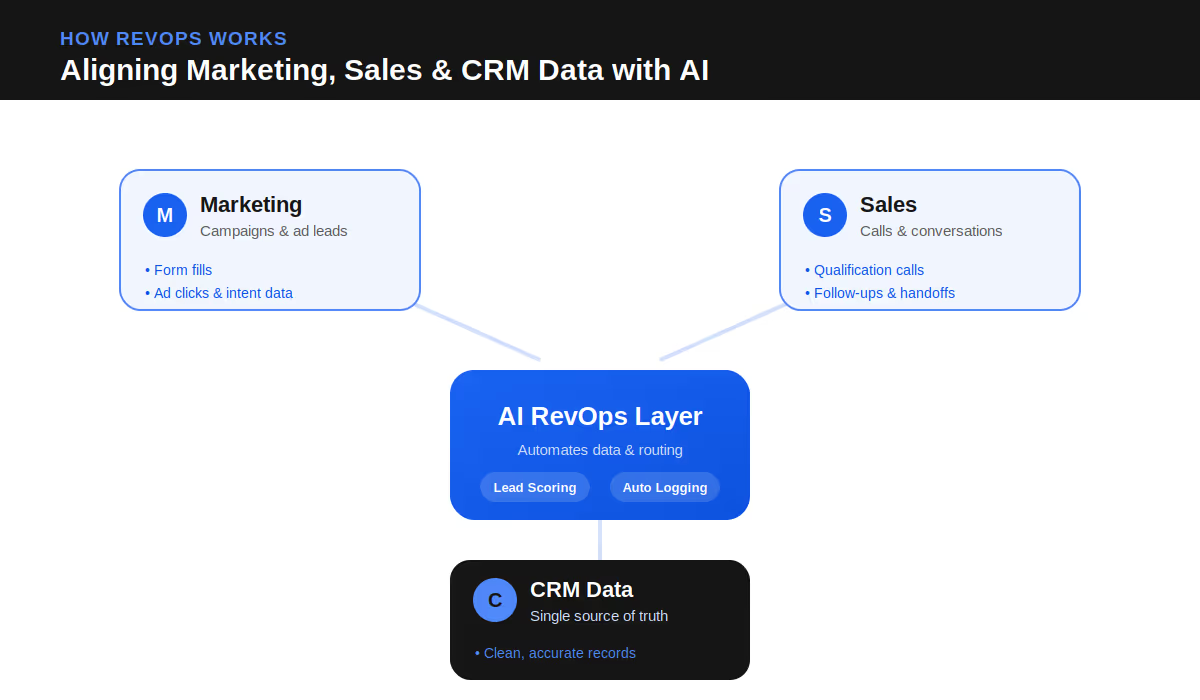
The core job of revenue operations is making sure marketing, sales, and CRM data all tell the same story — because in most B2C businesses, they don't.
Marketing might track a "lead" as anyone who filled out a form. Sales might only count someone a "lead" once they've had a real conversation. Support might have zero visibility into either. When these definitions don't match, reporting breaks, follow-up gets inconsistent, and leadership ends up making decisions on numbers that don't reflect reality.
RevOps aligns these teams through a few concrete mechanisms:
- Shared definitions — agreeing on what counts as a lead, a marketing-qualified lead, and a sales-qualified lead, so every team is speaking the same language.
- Automated lead routing — making sure inbound interest gets assigned to the right rep instantly, based on rules rather than manual triage.
- Unified CRM records — every touchpoint (ad click, form fill, call, chat) logged against one customer record instead of scattered across separate systems.
- Closed-loop reporting — feeding sales outcomes back to marketing so campaigns can be judged on actual revenue, not just lead volume.
Callveriq's piece on conversational AI integration for CRM data accuracy covers how automating data capture — rather than relying on reps to log everything manually — is often the fastest way to get marketing, sales, and CRM data actually aligned.
This blog is just the start.
Unlock the power of Callveriq’s AI with a live demo.

What Role Does AI Play?
This is where revenue operations have changed the most in the last few years. Historically, RevOps meant a lot of manual reporting, spreadsheet reconciliation, and CRM cleanup done by hand. AI has taken over much of that work, and it's doing it in real time instead of after the fact.
In practice, AI supports revenue operations in a few specific ways:
- Automatic CRM logging — AI voice and chat agents capture call and conversation details and write them straight into the CRM, so reps aren't manually entering notes after every interaction.
- Lead scoring and prioritization — AI models rank leads by intent and likelihood to convert, so sales teams work the leads most likely to close first instead of working strictly by order received.
- Gap and anomaly detection — AI flags stalled deals, missing follow-ups, or incomplete records before they become lost revenue, rather than surfacing the problem in a monthly report.
- Real-time handoffs — AI agents route qualified leads to the right rep the moment intent is detected, closing the delay between interest and outreach.
Callveriq's article on AI sales agents driving revenue and conversions breaks down how this plays out for sales teams specifically, and its piece on fixing decentralized data for better conversation analytics shows how AI helps unify scattered data sources into one accurate picture — which is the foundation RevOps depends on.
Signs You Need RevOps?
Not every B2C business needs a dedicated RevOps function right away, but certain patterns are strong signals that the gap between marketing, sales, and CRM data is already costing revenue:
- Leads sit untouched for hours or days because there's no automated routing telling anyone a new lead came in.
- Your CRM has duplicate, incomplete, or outdated records, because data entry depends on reps remembering to log it manually.
- Marketing and sales disagree on what a "qualified lead" even means, leading to finger-pointing over conversion rates.
- You can't tell which campaigns actually drive revenue, only which ones generate the most form fills or calls.
- Follow-up is inconsistent, with some leads getting called back in minutes and others never getting called at all.
If more than one or two of these sound familiar, it's usually a sign the business has outgrown ad hoc processes and needs the shared data, definitions, and automation that RevOps discipline brings. Callveriq's overview of problem-solving AI agents for sales teams has more examples of what this looks like once AI takes over the operational load.
How Do You Get Started?
Building revenue operations discipline doesn't require overhauling every system at once. Most B2C teams can start with a focused rollout:
- Audit your current data — find out where leads are getting lost or duplicated across marketing, sales, and CRM today.
- Agree on shared definitions — align marketing and sales on what counts as a lead, MQL, and SQL before automating anything.
- Automate data capture — use AI to log calls, chats, and form fills directly into the CRM instead of relying on manual entry.
- Set routing and scoring rules — make sure every qualified lead reaches the right rep automatically, prioritized by intent.
- Review and iterate monthly — use closed-loop reporting to see which channels and processes are actually driving revenue, then adjust.
Most businesses see the clearest wins by fixing data capture and lead routing first — the two places where B2C teams lose the most revenue silently.
Bottom Line
Revenue operations isn't about adding another layer of process for its own sake — it's about closing the gap where B2C businesses quietly lose revenue: between a lead showing interest and a rep actually following up with accurate information. AI has made that gap far easier to close, automatically capturing data, scoring leads, and routing them in real time instead of relying on reps to do it manually and consistently. For B2C teams dealing with high lead volume and fast-moving buyers, that shift — from fragmented systems to one aligned, AI-supported operation — is quickly becoming the difference between a pipeline you can trust and one you're guessing at.
FAQs
1. Is RevOps the same as sales operations?
No — sales ops focuses on the sales team alone, while RevOps aligns marketing, sales, and customer success around shared data and process.
2. Do small B2C businesses need RevOps, or just larger teams?
Any business with enough lead volume to create data gaps or inconsistent follow-up benefits, regardless of size.
3. Does adopting RevOps mean replacing our current CRM?
Not necessarily — RevOps is often about fixing how data flows into and out of the CRM you already use.
4. How quickly can AI improve CRM data accuracy?
Many teams see cleaner, more complete records almost immediately once calls and interactions are logged automatically instead of manually.
5. Does RevOps replace the need for a sales or marketing team?
No — it removes the manual, repetitive work so those teams can focus on selling and campaign strategy instead of data cleanup.