

Your customer doesn't think in "channels." They think about problems they want solved. They call, get cut off, jump to WhatsApp, then send an email that night, and to them, that's one conversation. To most support stacks, it's three strangers meeting for the first time.
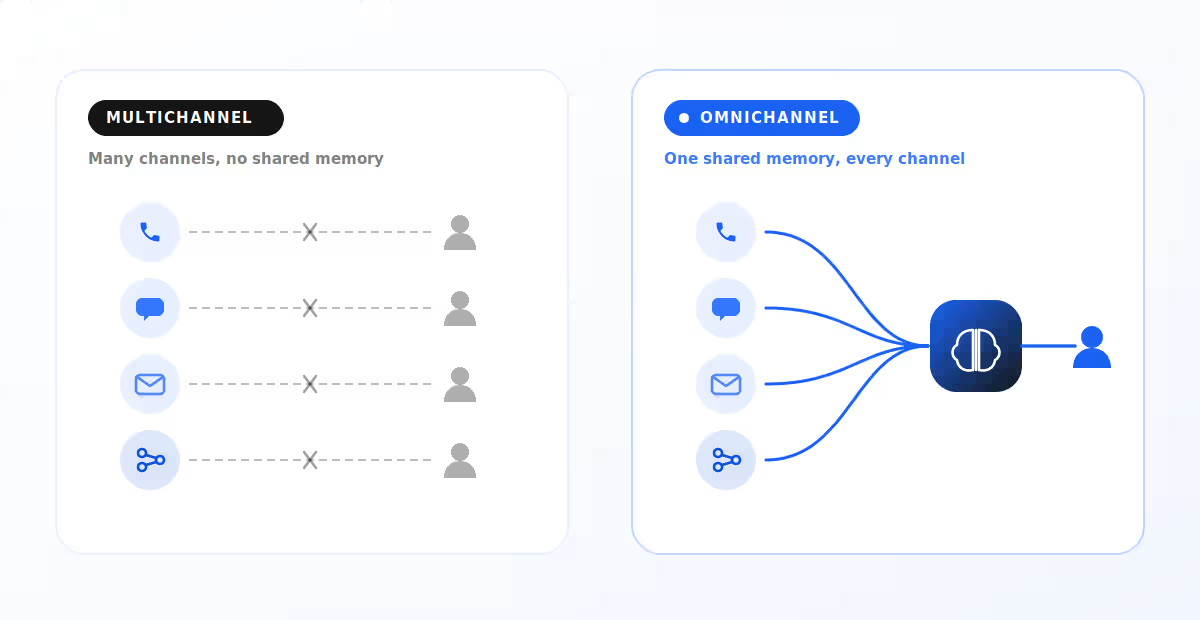
That gap is where omnichannel support lives or dies. True omnichannel support isn't the ability to answer on phone, chat, email, and social. That's just multichannel with better marketing. Real omnichannel means the context travels, so the customer never re-explains their order number, their issue, or their mood, no matter where the conversation moves.
The reason this has been so hard for so long is simple: channels were built as silos, and human memory doesn't scale across them. AI changes the math. By turning every interaction into structured, retrievable context, AI lets a contact center behave like one attentive person with perfect recall, across every touchpoint, at any volume. Here's how that actually works, and what it takes to get there.
See Callveriq Unify Every Channel
What Breaks Omnichannel Support Today?
Most teams believe they're already omnichannel because they're present on every channel. Presence isn't continuity. The breakage happens in the seams between channels, and customers feel every one of them.
Channels That Don't Talk
The classic failure mode is a stack of tools that each store their own version of the customer. A caller you resolved yesterday shows up in chat today as a blank slate, and agents burn the first ninety seconds of every interaction rebuilding what the system should already know. In practice, that looks like:
- Voice knows about the call, but not the follow-up email.
- Chat starts cold, with no memory of last week's ticket.
- Email replies as if the phone call never happened.
- Social DMs live in a queue nobody links back to the account.
This is the line between multichannel and true omnichannel, a distinction Callveriq unpacks in its guide to omnichannel customer engagement, where the whole point is one connected thread instead of parallel disconnected ones.
The Context Handoff Problem
Even inside a single team, context leaks at every handoff. A tier-1 agent escalates to tier-2 with a two-line note, the customer repeats the full story anyway, and the "relationship" resets to zero. Multiply that across shifts, channels, and departments, and support stops feeling like a conversation and starts feeling like a series of cold starts.
Why "More Channels" Isn't the Fix
Here's the trap most teams fall into: they treat coverage as continuity. Adding a WhatsApp line or a social DM queue without a shared context layer doesn't close the gap, it just multiplies the places a customer can be forgotten. More surface area, same broken memory:
- Coverage = how many channels you're on.
- Continuity = whether context follows the customer between them.
The 2026 buyer expects the second one, a shift Callveriq details in its breakdown of omnichannel customer experience strategies. Without shared memory, every new channel makes the repetition problem worse, not better.
Fix Your Channel Silos
How Does AI Unify Context?
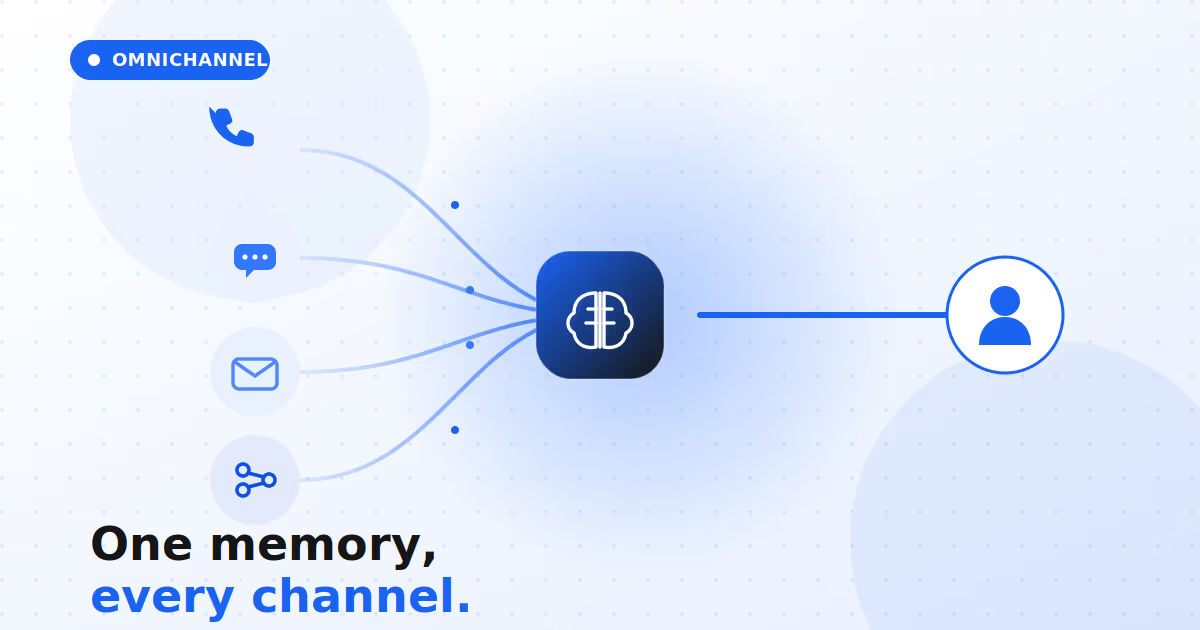
If the disease is fragmented memory, the cure is a unified one. AI's real contribution to omnichannel support isn't answering faster, it's remembering better, and making that memory available to every agent in real time.
1. One Profile, Every Touchpoint
AI stitches voice, chat, email, and social interactions into a single evolving customer profile. Every transcript, sentiment score, and resolution outcome feeds the same record. When the customer reappears on any channel, the full history is already loaded, no lookup, no repetition. Callveriq's conversation intelligence platform is built on exactly this: recording, transcribing, and analyzing every interaction so context becomes structured data instead of scattered notes.
2. Real-Time Context For Agents
Unified history is only useful if it reaches the agent during the conversation. That's where real-time surfacing matters, the moment a call connects, the agent (or AI) sees prior issues, promised follow-ups, and current sentiment. Callveriq's real-time Agent Assist does this live, pushing prior context, guided scripts, and battlecards so no agent starts blind.
3. Memory That Survives Escalation
Because the context lives in a shared layer rather than one agent's head, escalations stop resetting the customer. Tier-2 inherits the entire thread automatically. The handoff becomes invisible to the customer which is exactly how it should feel.
Give Your Agents Full Context
This blog is just the start.
Unlock the power of Callveriq’s AI with a live demo.

Why Do Customers Repeat Themselves?
Repetition is the single most-cited frustration in support, and it's almost always a symptom of a data problem, not a people problem. Agents ask again because the system never told them.
The Real Cost Of Repetition
Repetition looks harmless, but it quietly taxes every interaction it touches. Each time a customer re-explains their issue, the damage stacks up in ways friendliness can't reverse:
- Longer handle time - agents spend minutes rebuilding context instead of solving.
- Drained patience - by the third retelling, goodwill is already gone.
- A trust signal - it tells the customer the brand simply isn't paying attention.
Individually these are small frictions. Together, they're one of the quietest drivers of churn in support.
How Shared History Ends It
The fix is deceptively simple: surface the history before the agent has to ask. When prior interactions are unified automatically, the conversation opens with recognition instead of interrogation.
- Without it: "How can I help you today?"
- With it: "I see you called about your delayed order yesterday, let's finish that."
That shift from interrogation to continuation is the heart of consistent omnichannel support. It's the throughline in Callveriq's view of the 2026 omnichannel experience: context that follows the customer so they never repeat themselves.
Where AI Voice Agents Fit
Repetition isn't only a human-agent problem, automation gets it wrong too when bots run without memory. The fix is the same: give the AI the same context a person would have.
For high-volume, repetitive queries, AI voice agents can handle the interaction end-to-end with full history, reading the same unified profile a human would. Callveriq's AI Phone Calls run autonomous conversations across support, sales, and collections while pulling from that shared context store, so the automated path stays as continuous as the human one.
Stop Making Customers Repeat Themselves
Which Callveriq Tools Power This?
Consistent cross-channel help isn't one feature, it's a stack where each layer feeds the next. Callveriq's platform is organized around a simple loop:
- Capture every interaction into a shared context layer.
- Assist agents in real time using that context.
- Automate the repetitive work without breaking continuity.
Each layer only works because the one beneath it exists. Here's how they stack up.
Conversation Intelligence As The Base
Everything starts with capture. Conversation intelligence records and analyzes every voice and digital interaction, turning raw conversations into the structured context layer the rest of the system draws from.
Without this foundation, "omnichannel" is just a dashboard with tabs, channels sitting side by side, sharing nothing.
Agent Assist In The Moment
On top of that base, real-time Agent Assist works while the conversation is happening, not after. It gives agents what they need mid-call:
- Live prompts that suggest the next best response.
- Dynamic battlecards for objection handling and tricky tasks.
- Compliance nudges so the right things get said every time.
Callveriq reports this kind of live guidance drives meaningfully faster resolution by cutting the time agents waste hunting for information mid-call.
AI Phone Calls At Scale
When volume outpaces headcount, AI Phone Calls take the repetitive load, payment reminders, status updates, lead qualification, while human agents focus on complex, high-empathy cases.
Because both run on the same unified context, customers get a consistent experience whether they reach a person or a voice agent. Callveriq frames this whole capture-assist-automate loop in its overview of contact center technology.
Watch Callveriq Handle Live Calls
How To Measure Omnichannel Success?
If you can't measure continuity, you can't defend the investment. The good news: the metrics that prove omnichannel support is working are the same ones executives already care about.
The Metrics That Actually Matter
The three core metrics are ones your leadership already tracks, unified context should move all of them in the right direction:
- Average Handle Time (AHT) - down, because agents stop reconstructing history.
- First Contact Resolution (FCR) - up, with fewer transfers and callbacks.
- CSAT - up, because customers feel remembered instead of processed.
Callveriq reports outcomes like a 56-second AHT reduction and CSAT gains of 27% for teams running its real-time stack, useful benchmarks to hold your own results against.
Repetition Rate As A Signal
Then add the one metric most teams miss: how often customers re-explain their issue. It's the cleanest proxy for whether your context layer is actually doing its job.
A falling repetition rate is direct evidence that history is following the customer across channels, and it usually moves before CSAT does, so it's an early signal your investment is working.
Choosing The Right Platform
The numbers only move if the platform genuinely unifies channels instead of bolting them together. When you evaluate options, look for the non-negotiables:
- Real-time insight during the conversation, not just after.
- Shared context that every agent and bot can read.
- Native voice + digital support, not a patchwork of point tools.
Callveriq's guide to omnichannel contact center software lays out what separates true unification from a stitched-together stack.
Book Your Free Callveriq Demo
The Bottom Line On Consistent Support
Omnichannel support was never about being everywhere. It's about being the same everywhere, one memory, one thread, one continuous relationship no matter how many times or ways the customer reaches out. The teams that win in 2026 won't be the ones with the most channels. They'll be the ones where switching channels costs the customer nothing, because the context always travels with them.
AI is what makes that continuity affordable at scale: it captures every interaction, surfaces the right history at the right moment, and lets human and AI agents pick up mid-story instead of starting over. Get that layer right, and "How can I help you today?" quietly becomes "I already know why you're here, let's finish this."
Get started with Callveriq’s solution today
FAQs
1. What is omnichannel support?
It's a support model where customer context travels across every channel, voice, chat, email, social, so the experience stays continuous no matter where the conversation moves. It's different from multichannel, which offers many channels but no shared memory.
2. How is omnichannel different from multichannel?
Multichannel means you're present on many channels. Omnichannel means those channels share context, so a customer never repeats their history when switching from one to another.
3. How does AI stop customers from repeating themselves?
AI unifies past interactions into a single profile and surfaces it in real time, so the agent opens with the customer's history already loaded instead of asking them to re-explain.
4. Can AI voice agents maintain the same context as human agents?
Yes. When voice agents draw from the same unified context store, they carry full customer history into automated calls, keeping the experience consistent across human and AI touchpoints.
5. Which metrics show omnichannel support is working?
Watch AHT, FCR, and CSAT together, plus repetition rate. Falling AHT and repetition alongside rising FCR and CSAT signal that context is successfully following the customer.