

Instead of one generalist bot trying (and failing) to do everything, multi-agent AI distributes the work the way a well-run team would: one agent verifies identity, another checks order status, a third handles billing disputes, and a coordinating layer makes sure none of them lose the thread. The result is faster resolutions, fewer dropped handoffs, and a customer journey that finally feels like it was designed on purpose.
This blog breaks down what multi-agent AI actually is, how it's architected, and why it's quickly becoming the backbone of modern omnichannel customer experience.
Ready to see multi-agent AI in action?
What Is Multi-Agent AI and Why It Matters Now
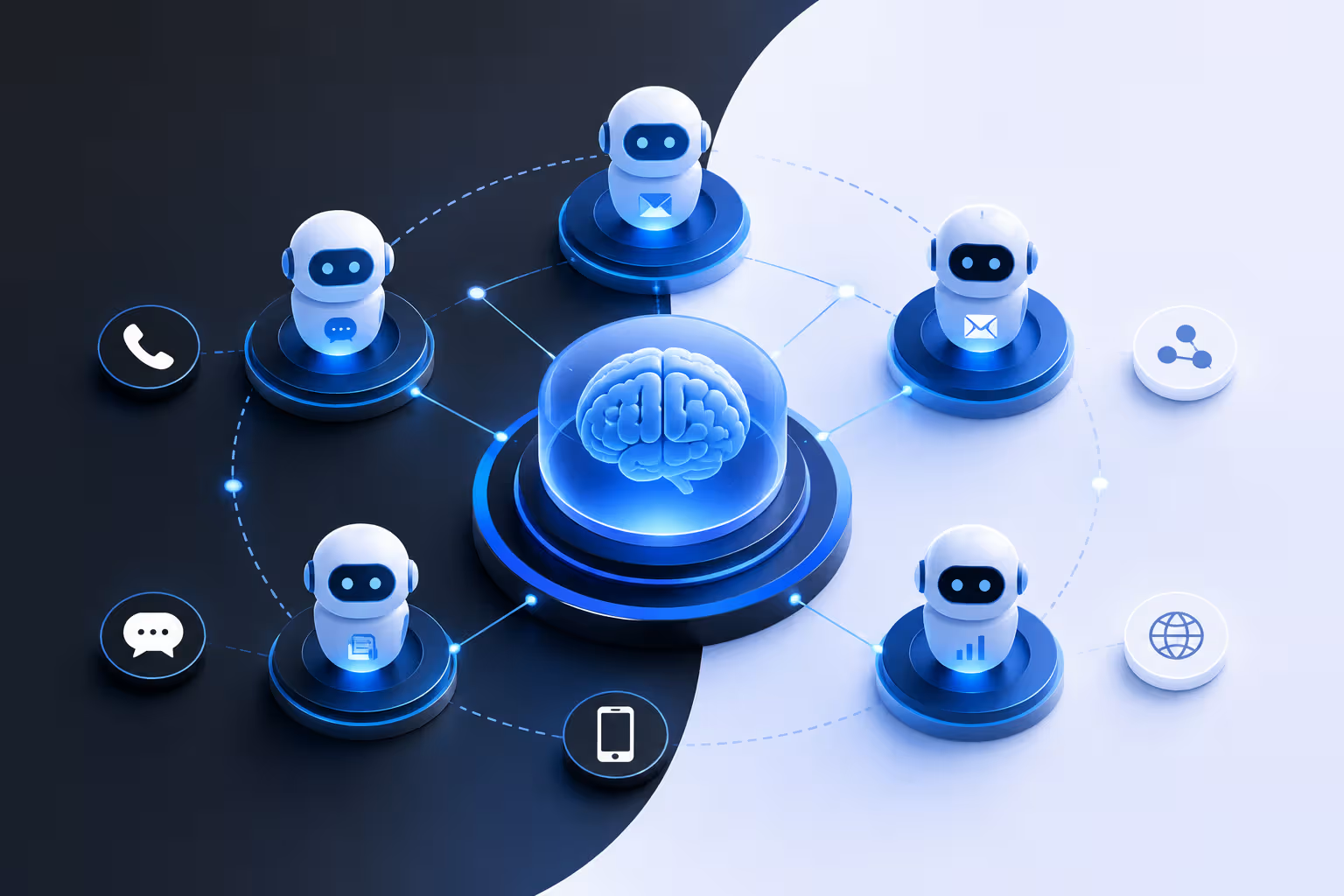
Multi-agent AI refers to a system of multiple autonomous AI agents, each built for a specific function, that collaborate to complete a larger task. Rather than relying on one monolithic model to understand billing, technical support, scheduling, and escalations all at once, the workload is split across specialists that communicate with each other in real time.
This matters now because customer expectations have outpaced what single-agent bots can deliver:
- People expect a query raised on chat to be understood if they call five minutes later.
- They expect a complaint filed on email to be visible to the voice agent who calls them back.
- They expect every touchpoint to feel like one conversation, not five separate ones.
Multi-agent systems make that continuity possible because the underlying architecture is built around shared context, not isolated scripts.
The Limits of Single-Agent Chatbots in Complex Journeys
Traditional chatbots are built to follow a decision tree. They work fine for "what are your business hours" but fall apart the moment a customer's request branches into multiple domains, say, a refund request that also involves a shipping delay and a loyalty point adjustment. A single-agent bot either loops the customer in circles or escalates immediately, defeating the purpose of automation. As Callveriq explains in its guide to AI agent architecture, the key to building a successful agentic architecture is ensuring that agents are organized to handle this kind of complexity rather than choke on it.
Why Customer Expectations Have Outgrown Scripted Bots
Customers today compare every brand interaction to the best one they've had anywhere, including with platforms that already use sophisticated personalization and instant resolution. Scripted bots can't adapt to context shifts mid-conversation, which is exactly what real customer journeys are full of. Multi-agent systems solve this by letting specialized agents take over the moment a conversation moves outside their scope, instead of forcing one rigid script to stretch beyond its design.
The Business Cost of Disconnected Channel Experiences
When channels don't talk to each other, the costs show up quickly:
- Customers repeat themselves, which feels like the brand wasn't listening the first time.
- Agents lose context and have to rebuild it from scratch on every handoff.
- Resolution times balloon, dragging down CSAT and pushing up cost-per-resolution.
Each repeated explanation is a small trust withdrawal. Over enough interactions, that adds up to churn, because human agents end up redoing work the bot already attempted.
How Multi-Agent Systems Mirror Human Team Structures
The most intuitive way to understand multi-agent AI is to think of it as a team rather than a tool. As Microsoft's breakdown of multi-agentic systems puts it, these systems use a series of agents, with a single coordinating agent, to work as a sort of AI team. Just like a human support team has a frontline rep, a billing specialist, and a manager who steps in for exceptions, a multi-agent system assigns each function to an agent built for it.
Early Signals: Where Multi-Agent AI Is Already Proving Itself
Industries with high interaction volume and high complexity are the first adopters:
- Cybersecurity - a multi-agentic security platform now automates the majority of incident investigations and response tasks, functioning as an always-on security operations team that analyzes data, flags suspicious activity, and manages incidents autonomously.
- Contact centers - using multi-agent setups, as outlined in Callveriq's piece on the best AI agents to watch in 2025, to manage collections, support, and sales conversations that used to require constant human supervision.
- Retail and telecom - running parallel agents for order tracking, billing, and retention outreach without losing the thread between them.
See multi-agent AI handle real conversations
How Does Multi-Agent AI Work?
Underneath every effective multi-agent deployment is a structure that defines how agents are created, how they specialize, and how they hand off work without losing context. This is often called agentic AI architecture, and it's the difference between a system that scales gracefully and one that breaks under its own complexity.
Specialized Agents: Dividing Labor by Function
As Callveriq's own agentic architecture demonstrates, multi-agent architecture enables multiple agents, each with specialized skills, to collaborate and solve problems in a way that single-agent systems cannot. In practice:
- One agent might handle customer inquiries related to billing.
- Another manages technical support requests with its own troubleshooting knowledge base.
- A third focuses solely on scheduling, retention, or compliance-sensitive conversations.
The Coordinating Agent: Orchestrating the Workflow
Specialization only works if something ties it together. As Microsoft's look at multi-agentic systems explains, the coordinating agent works to understand complex queries and delegate workflows to other agents, making multi-step, multi-system queries possible. This orchestration layer is what prevents the "multiple bots talking past each other" problem that plagued earlier automation attempts.
Shared Memory and Context Across Agents
For a handoff to feel seamless to the customer, every agent in the chain needs access to the same conversation history. According to Aisera's explanation of agentic AI, the effectiveness of agentic AI is rooted in a cycle of Perception, Reasoning, Action, and Memory, and memory is what lets a billing agent pick up exactly where a technical support agent left off, without asking the customer to repeat themselves.
Perception and Reasoning: How Agents Interpret Customer Intent
Before an agent can act, it has to understand what's actually being asked. That same agentic AI overview notes that perception is the agent's ability to "see" and "sense" its environment to interpret context dynamically, processing unstructured multimodal inputs such as text, voice, images, and screen context simultaneously, rather than relying only on rigid structured data. This is what allows an agent to correctly route a vaguely worded complaint to the right specialist.
Reliability and Failover Between Agents
A major advantage of distributing work across agents is resilience:
- If one agent encounters an issue, others can continue processing tasks without interruption.
- This reduces the risk of system failures and downtime, which matters enormously for 24/7 support operations.
- It removes the single point of failure that plagues monolithic, single-bot deployments.
This is exactly why reliability sits at the center of Callveriq's agentic architecture rather than being treated as an afterthought.
This blog is just the start.
Unlock the power of Callveriq’s AI with a live demo.

Can Multi-Agent AI Transform Omnichannel CX?
A great omnichannel customer experience isn't about being present on every channel, it's about being consistent across them. Multi-agent AI is what actually makes that consistency operationally possible, because the same coordinating layer that manages agent-to-agent handoffs can also manage channel-to-channel handoffs.
Unifying Voice, Chat, Email, and Social in One System
As businesses continue to adapt to evolving consumer expectations, Callveriq's guide to the best omnichannel contact center software frames omnichannel support as a critical strategy for seamless, integrated customer interactions, one where communication becomes not only consistent across channels but also intelligent, predictive, and efficient. In a multi-agent setup, this looks like:
- A voice agent that handles live calls and escalations.
- A chat agent built for quick, text-based resolutions.
- An email agent for asynchronous, detail-heavy requests.
- A social agent monitoring and responding on public platforms.
Maintaining Context When Customers Switch Channels
The real test of an omnichannel system is what happens when a customer abandons one channel for another mid-issue. As outlined in Callveriq's piece on contact center technology for better customer service, customers increasingly expect personalized support on social platforms to integrate seamlessly with other channels, addressing queries without losing context and ensuring continuity in communication. A multi-agent setup handles this naturally because context lives at the system level, not inside any single bot's memory.
Personalization at Scale Across Every Touchpoint
Personalization usually breaks down at scale because static rules can't account for every variation in customer history. As Callveriq notes in its breakdown of the best AI agents to watch in 2025, using dynamic variables to personalize at scale lets agents tailor tone, recommendations, and resolution paths to the individual customer without needing a human to manually configure every scenario.
Real-Time Handoffs Between AI Agents and Human Teams
Not every conversation should stay fully automated, and good multi-agent design knows when to step back. Callveriq's work on AI agents for sales teams describes exactly this kind of seamless handoff: when a lead shows interest, the system automatically transfers the call to a live agent, ensuring a smooth transition and personalized follow-up. The goal isn't to remove humans, it's to make sure they only get pulled in when their judgment actually adds value.
Industry Examples: Retail, Telecom, and Financial Services
A few patterns show up repeatedly across industries:
- Retail brands use multi-agent setups to manage everything from order tracking to return approvals without losing the thread across digital and voice channels.
- Telecom providers lean on the same approach for plan changes and billing disputes that often start on one channel and escalate to another, using predictive analytics to identify at-risk customers and offer retention deals before they churn.
- Financial services firms apply multi-agent routing to fraud alerts, dispute resolution, and account servicing, where speed and accuracy both matter equally.
How Can AI Optimize Journeys?
Customer journey orchestration is about more than routing, it's about anticipating what a customer needs next and making sure the right agent, channel, and information are ready before they ask. Multi-agent AI gives orchestration the intelligence layer it's always been missing.
Mapping the Journey Before Automating It
You can't orchestrate a journey you haven't mapped. As Callveriq's guide to customer service journey analytics explains, advanced AI technology can transform customer journey mapping by providing comprehensive insights and actionable intelligence across every touchpoint, giving businesses the visibility they need before assigning specific agents to specific journey stages.
Predictive Routing: Getting Customers to the Right Agent First Time
Routing shouldn't be reactive. According to Callveriq's roundup of leading customer intelligence platforms, leveraging data from past interactions allows automatic routing of calls to the most suitable agent or department, reducing wait times and improving first-call resolution rates. In a multi-agent system, this routing logic extends to AI agents themselves:
- The orchestration layer reads intent before a human ever gets involved.
- It decides which specialist agent should engage first.
- It escalates to a human only when the situation genuinely requires it.
Proactive Intervention Before Issues Escalate
The best orchestration catches problems before the customer has to raise them. That same customer intelligence platforms guide points out that leveraging insights from customer journey analytics lets agents anticipate issues before they become problems and offer solutions proactively, significantly enhancing the overall experience.
Closing the Loop with Continuous Feedback
Orchestration isn't a one-time setup, it has to keep adjusting. As the same source notes, implementing changes based on consistent feedback through voice-of-customer solutions ensures that services continuously evolve to meet customer needs, increasing overall satisfaction. Multi-agent systems make this easier because every agent's performance data feeds back into the same orchestration model.
Measuring Journey Health: The Metrics That Matter
A handful of metrics tell you whether orchestration is actually working:
- First-contact resolution - are issues closing on the first interaction, regardless of channel?
- Channel-switch frequency - how often do customers need to jump channels to get an answer?
- Time-to-resolution - measured across the entire journey, not just within one channel.
When these metrics improve together, it's a sign the agents are actually coordinating rather than just operating in parallel.
Can AI Transform Contact Center Operations?
For most businesses, the practical entry point into multi-agent AI is contact center automation. This is where the technology meets daily operational reality, call volumes, staffing constraints, and compliance requirements all at once.
Starting with High-Volume, Low-Complexity Workflows
The safest place to deploy multi-agent AI first is in workflows with high volume but low ambiguity:
- Appointment confirmations and reminders.
- Payment and collections follow-ups.
- Simple order or ticket status checks.
As Callveriq's piece on AI agent features to watch in 2025 points out, a collections team using AI agents can reduce manual call volume by 60% while improving recovery rates, proving out the model before expanding into more complex journeys.
Integrating Agents with Existing CRM and Workflow Tools
Multi-agent AI only adds value if it plugs into the systems already running the business. Callveriq's overview of top AI-powered call center software tools notes that platforms offering omnichannel support and real-time analytics are tailored for businesses of all sizes, but it's the integration with CRM, ticketing, and workforce management tools that actually turns those features into operational results.
Compliance and Security in Multi-Channel Automation
Automation at scale raises the stakes on data protection. Callveriq's piece on the automated customer journey in e-retail call centers highlights how malware detection protecting customer data during digital journeys can safeguard sensitive information exchanged over calls and digital channels, detecting suspicious activity in real time across every omnichannel touchpoint. Any contact center automation strategy needs this layer built in from day one, not bolted on after deployment.
Scaling Without Sacrificing Quality
The architecture itself is designed for this kind of growth. As Callveriq's agentic architecture guide puts it, multi-agent architecture easily adapts to handle growing customer demand as a business expands, which is precisely why it outperforms single-agent systems once volume and complexity both increase at the same time.
What’s Next for Multi-Agent AI in Customer Experience?
The future of customer experience lies in coordinated, intelligent AI systems rather than standalone chatbots. As businesses expand across multiple channels, customers increasingly expect seamless, context-aware interactions that continue effortlessly from one touchpoint to another. Multi-agent AI makes this possible by enabling specialized AI agents to work together like a well-organized support team, sharing information, maintaining context, and delivering consistent experiences throughout the customer journey.
As agentic AI becomes more widely adopted, contact centers will evolve from simply automating repetitive tasks to managing entire customer journeys. Organizations that embrace multi-agent AI early will be better positioned to provide the personalized, frictionless, and omnichannel experiences that modern customers demand. The real question is no longer whether businesses should adopt multi-agent AI, but how quickly they can put it into action.
Get started with Callveriq’s solution today
FAQ’s
1. What is multi-agent AI?
Multi-agent AI is an AI framework where multiple specialized AI systems work together to complete complex tasks. Each agent handles a specific function while collaborating with other agents to achieve a shared goal.
2. How does multi-agent AI improve customer journeys?
Multi-agent AI improves customer journeys by enabling different AI agents to share context across channels. This creates a seamless experience and ensures customers do not have to repeat information when switching between touchpoints.
3. What is the difference between multi-agent AI and agentic AI?
Agentic AI refers to AI systems that can make decisions and take actions autonomously. Multi-agent AI is a system where multiple agentic AI systems or AI agents collaborate to solve complex problems and manage end-to-end workflows.
4. How does multi-agent AI support contact center automation?
Multi-agent AI enhances contact center automation by automating tasks such as call routing, sentiment analysis, quality monitoring, knowledge retrieval, agent assistance, and post-call summaries. This helps teams improve efficiency and reduce operational costs.
5. Why is multi-agent AI important for omnichannel customer experience?
Modern customers interact through multiple channels, including calls, chat, email, and social media. Multi-agent AI helps maintain context across these channels, enabling a consistent omnichannel customer experience and better customer journey orchestration.