

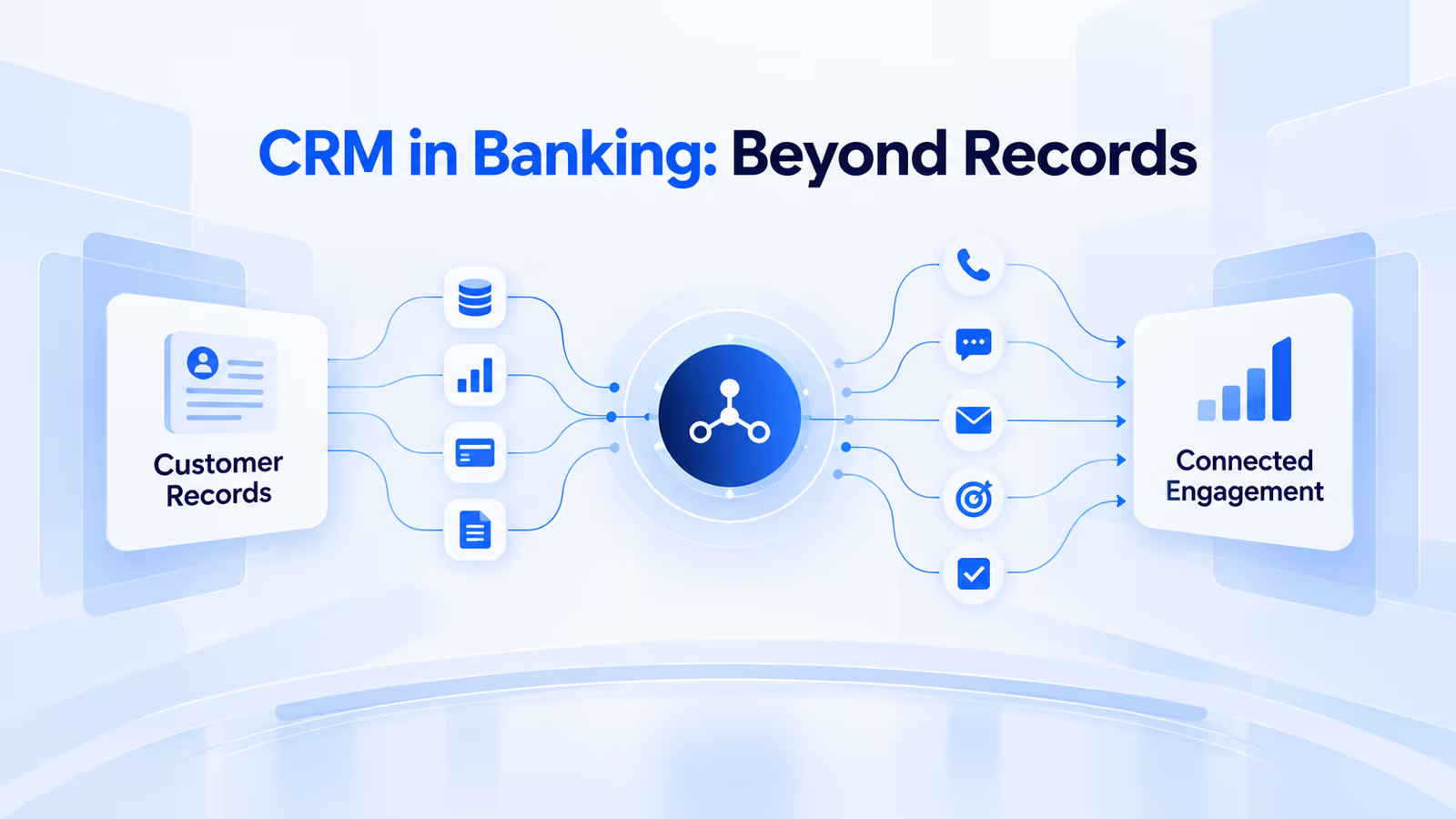
An omnichannel customer-engagement layer turns the information stored in CRM in banking into coordinated action. It can conduct approved conversations, understand customer intent, trigger contextual follow-ups, maintain continuity across channels, and return structured outcomes to the CRM. Banks therefore need to assess CRM in banking as the system of record and omnichannel AI as the system of engagement.
Why Customer Journeys Break Despite Having a Banking CRM
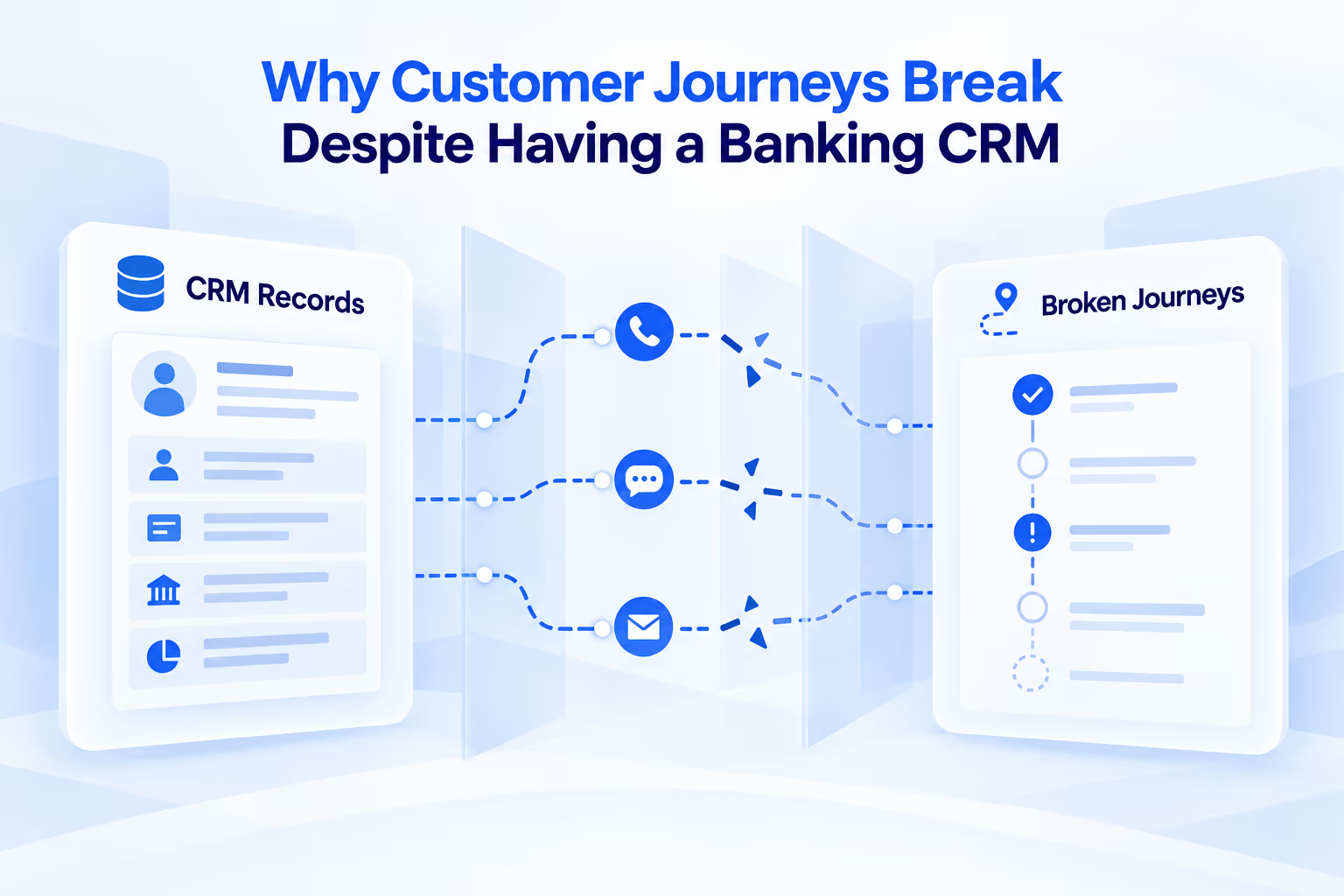
A borrower receives an EMI reminder and asks for a callback after 6 p.m. The request is recorded in the CRM in banking, but the outbound calling platform cannot read it. Another call arrives the next morning. A generic SMS follows. When the borrower contacts support, the agent can see the account but not the reason behind the previous interaction.
The customer has now interacted with four systems. Every system may have recorded an event, but none has managed the journey.
This is the operational boundary many banks discover after implementing CRM in banking. Customer records become centralized, but customer conversations remain distributed across independent tools, teams, queues, and channel providers.
CRM in banking can show that a call occurred. It may not show that the customer promised to pay on Friday, requested communication in Hindi, disputed the amount, or asked the bank to stop calling during office hours. Even when a CRM in banking captures that information, downstream systems may not use it before initiating the next interaction.
The result is familiar:
- Customers repeat information across channels
- Agents receive tasks without conversational context
- Campaigns continue after payments or complaints
- Channel preferences are stored but not followed
- Escalations move cases without transferring intent
- Different teams create overlapping communication
- Managers measure activity without measuring resolution
KPMG’s India CX Report 2025 for financial services found that 51% of customers emphasized experience while purchasing and using primary financial services. The report also found that 48% of switchers in non-banking financial services sought greater transparency in processes and communication.
CRM in banking provides the information needed to improve that experience. An engagement layer ensures the information changes the conversation.
Unify fragmented journeys using Callveriq.
What CRM in Banking Is Designed to Manage
CRM in banking gives employees and connected applications a consistent customer record. Depending on the platform and implementation, CRM in banking may manage customer profiles, service requests, complaints, product holdings, lead opportunities, consent, campaign membership, and relationship-manager tasks.
1. Customer and Household Records
CRM in banking can combine customer identity, demographic details, product relationships, contact preferences, service history, and household connections.
This information helps the bank understand the broader relationship instead of treating every account or interaction independently.
2. Lead and Opportunity Management
CRM in banking can capture leads from websites, branches, campaigns, partners, and referrals. It can assign those leads, track their progress, record responses, and show which opportunities require follow-up.
3. Service and Complaint Management
CRM in banking can create cases, assign owners, monitor service-level agreements, and preserve a history of actions taken. This gives managers greater control over pending service work and complaint resolution.
4. Campaign Segmentation
CRM in banking can segment customers using product eligibility, activity, risk, geography, preferences, and previous campaign responses.
The CRM can identify who should enter a campaign. It may still depend on another application to conduct and coordinate the conversation.
5. Employee Work Management
CRM in banking can create tasks for relationship managers, service teams, collection agents, and sales representatives. It supports accountability by showing who owns the next action.
The limitation is that task creation does not ensure timely completion. High-volume reminders can remain constrained by staffing, agent availability, working hours, and manual dispositioning.
CRM in banking is therefore a foundational operational system. The gap appears when banks expect CRM in banking to conduct every conversation or coordinate every channel without an additional engagement layer.
Extend banking CRM through Callveriq.
This blog is just the start.
Unlock the power of Callveriq’s AI with a live demo.

How Omnichannel Engagement Differs From CRM in Banking
An omnichannel customer-engagement layer coordinates customer-facing communication across voice and digital channels. It uses the information available in CRM in banking, core platforms, loan systems, payment systems, and service applications to determine what should happen next.
The distinction can be summarized through three questions:
- CRM in banking asks: What do we know about this customer?
- Decisioning asks: What action is appropriate?
- Omnichannel engagement asks: How should that action be conducted and continued?
Salesforce’s 2025 Connected Financial Services research surveyed 9,500 financial-services consumers worldwide. The research examined how customers assess their institution’s digital experience and highlighted the need for relevant engagement, transparent AI, and accessible human support.
CRM in banking helps create relevant engagement by supplying customer context. Omnichannel AI uses that context to conduct an appropriate conversation.
For example, CRM in banking may show that a borrower has an overdue EMI, prefers Hindi, recently requested a callback, and has an unresolved complaint. An omnichannel layer should use all four conditions before initiating another interaction.
Without that connection, CRM in banking becomes a reliable memory attached to an unreliable customer journey.
Activate customer context through Callveriq.
Where CRM in Banking Workflows Commonly Stop
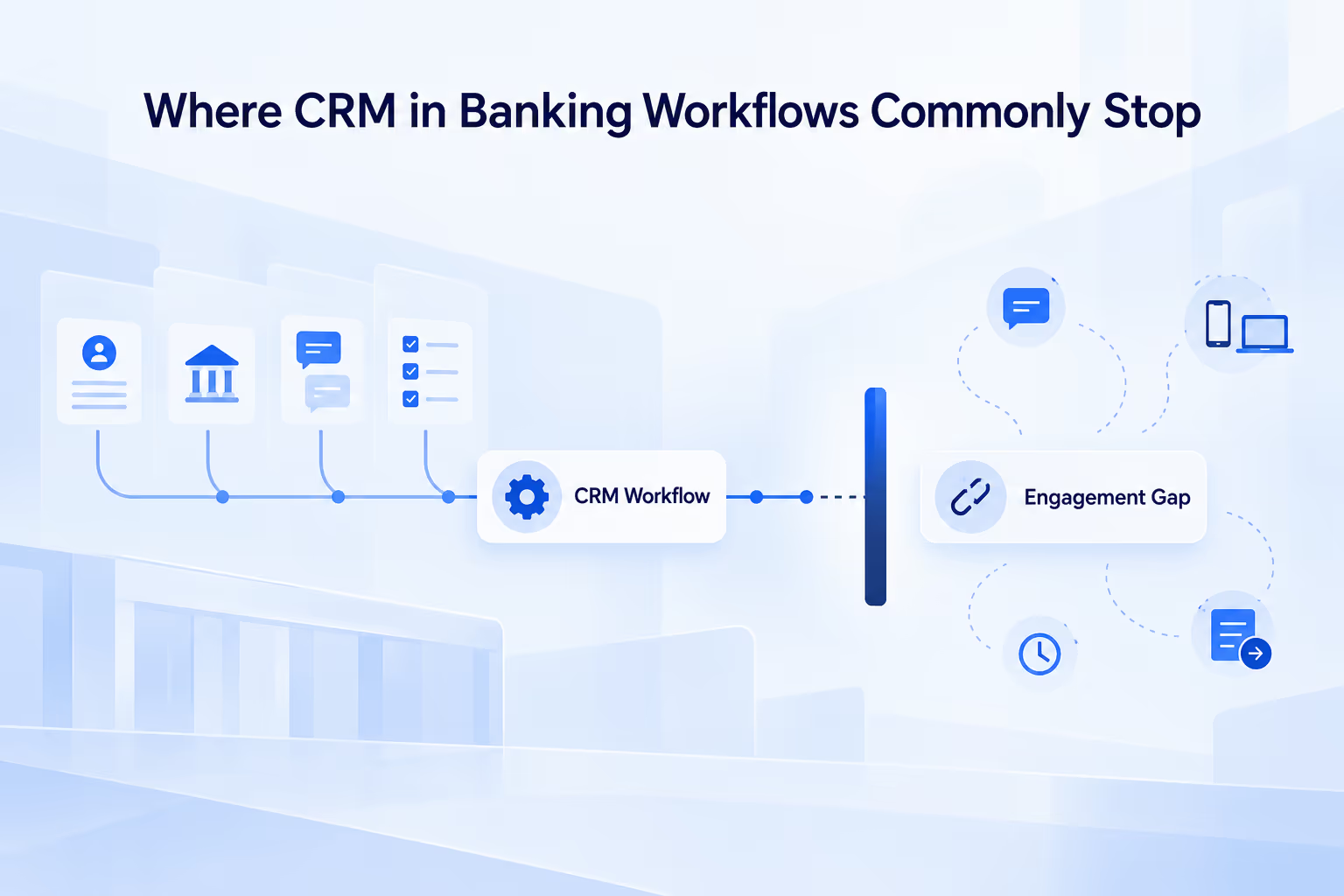
- A Task Is Created but the Conversation Waits
CRM in banking can assign a task to an employee. The task still depends on agent availability, queue prioritization, shift capacity, and manual execution.
For high-volume journeys such as KYC reminders, EMI notifications, renewal outreach, and lead follow-up, CRM in banking may create more work than employees can complete within the required window.
- A Channel Records Activity Without Capturing Intent
A calling platform may tell CRM in banking that a call connected. A messaging provider may report that a message was delivered.
Neither event explains what the customer wanted.
Useful intent data includes:
- Promise-to-pay date
- Preferred callback time
- Payment-link request
- Language preference
- Document-submission difficulty
- Amount dispute
- Hardship notification
- Complaint or escalation request
- Consent withdrawal
CRM in banking should receive these outcomes in structured fields that another workflow can use.
- Different Channels Apply Different Rules
Voice, email, SMS, and WhatsApp campaigns may maintain independent schedules and retry rules. CRM in banking can then show several recent activities while the customer still receives duplicate communication.
A connected journey needs shared suppression logic for:
- Recent payments
- Active complaints
- Existing promises
- Opt-outs
- Callback commitments
- Disputes
- Human-agent ownership
- Communication-frequency limits
- Human Escalations Lose Context
When an automated conversation transfers only a customer ID or case number, the agent must reconstruct the problem.
CRM in banking should receive a structured summary, detected intent, previous actions, relevant transcript or recording references, and the reason for escalation.
- Customer Responses Do Not Change Future Communication
A customer may ask for a written reminder or request another language. If the response is stored as an unstructured note in the CRM in banking, the next channel may ignore it.
An omnichannel layer should convert conversational responses into operational events that change future outreach.
Gartner’s 2025 customer-service AI forecast predicts that agentic AI could autonomously resolve 80% of common customer-service issues by 2029. Banks should treat this as a market forecast rather than a guaranteed local outcome. CRM in banking integrations still require controlled pilots, clear boundaries, and measurable success criteria.
Repair banking handoffs using Callveriq.
Which Banking Journeys Need CRM and Omnichannel AI
CRM in banking and omnichannel engagement are complementary in journeys that require both dependable records and timely customer conversations.
- Lead Follow-Up
CRM in banking stores the lead source, product interest, owner, eligibility, and previous activity.
Omnichannel AI can contact the prospect, qualify interest, understand objections, schedule the next action, and return a structured outcome to CRM in banking.
- KYC Completion
CRM in banking tracks application status and missing documents.
An engagement layer can explain the approved requirement, answer routine questions, send a secure submission link, and escalate customers who cannot complete the process.
- EMI Reminders and Collections
CRM in banking supplies the outstanding amount, due date, delinquency stage, previous attempts, and communication restrictions.
An AI voice agent can conduct an approved reminder, capture a promise date, send a payment link, and transfer disputes or hardship cases.
- Renewals
CRM in banking identifies eligible customers and upcoming renewal dates.
Omnichannel AI can explain the next step, capture renewal intent, schedule assistance, and continue the journey through the preferred channel.
- Service Requests
CRM in banking holds the case status, ownership, and service history.
An engagement layer can provide proactive updates, request missing information, and prevent customers from calling merely to ask for status.
- Complaint Management
CRM in banking preserves the formal complaint record.
Omnichannel engagement can acknowledge the complaint, provide approved status updates, detect repeated contact, and transfer unresolved conversations to the grievance team.
McKinsey’s Global Banking Annual Review 2026 reports that leading banks using customer-value-management engines are improving customer engagement by 20–30 percentage points and customer value by 10–25%. McKinsey describes an engine that combines customer data, decision models, engagement technology, and an operating model.
That combination is broader than CRM in banking alone.
Coordinate banking journeys with Callveriq.
How Banks Should Evaluate an Engagement Layer
A bank should not begin with a generic omnichannel demonstration. It should select one measurable journey and assess how the platform uses CRM in banking throughout that journey.
1. Integration
The engagement platform should read the correct customer, product, consent, language, and journey context from CRM in banking.
It should also return structured outcomes without creating duplicate or conflicting records.
2. Conversation Quality
The platform should understand expected customer intents, regional-language requirements, code-switching, objections, and approved escalation conditions.
3. Cross-Channel Continuity
A conversation started on voice should be able to continue through an approved messaging or human-assisted workflow without asking the customer to repeat information.
4. Governance
Banks should be able to inspect rules, prompts, knowledge sources, workflow versions, access controls, interaction records, failures, and employee overrides.
5. Suppression and Contact Controls
The engagement platform should stop or change outreach after payments, promises, complaints, disputes, opt-outs, or human intervention.
6. Outcome Measurement
CRM in banking metrics such as records updated or tasks created should be combined with:
- Right-party contact rate
- Meaningful conversation rate
- Completed-action rate
- Automated-resolution rate
- Escalation accuracy
- Duplicate-contact rate
- Complaint rate
- CRM update accuracy
- Cost per successful outcome
KPMG’s describes how AI can improve banking operations while supporting faster and more responsive customer experiences. The operational requirement is controlled integration: CRM in banking remains governed, the engagement system uses approved data, and every material outcome returns to the bank’s systems.
Evaluate connected engagement with Callveriq.
How Callveriq Complements CRM in Banking
Callveriq provides a conversational and orchestration layer around CRM in banking. Its AI agents can conduct approved voice and digital interactions, understand customer intent, capture structured dispositions, trigger follow-ups, and escalate exceptions. CRM in banking continues to control customer records, cases, ownership, consent, and product context. Callveriq uses that information to make each interaction relevant.
For collections, CRM in banking may provide the due amount, delinquency stage, language preference, recent payment status, and previous outcomes. Callveriq can conduct a reminder, capture a promise date, send an approved payment link, and update CRM in banking.
For lead qualification, CRM in banking supplies lead and campaign data. Callveriq can contact the prospect, understand interest, record objections, and schedule a sales conversation.
For service requests, CRM in banking provides the current case status. Callveriq can communicate approved updates, collect missing details, and escalate a customer who needs further help.
Salesforce’s 2025 financial-services AI research highlights customer expectations for faster service while emphasizing the importance of trust. Callveriq helps banks apply CRM in banking context without removing human access from sensitive or complex conversations.
A Callveriq pilot should test:
CRM in banking should remain the dependable record. Callveriq makes that record useful during the live customer journey.
Connect your banking CRM through Callveriq.
CRM in Banking Needs an Engagement Layer
CRM in banking remains essential because banks need a controlled record of customers, products, opportunities, service cases, permissions, and previous activity. It gives employees and connected systems a shared understanding of the customer.
The limitation appears when banks expect CRM in banking to coordinate every conversation independently. A record can show what happened without ensuring that the next interaction reflects it. Tasks can be created without being completed. Channel events can be stored without revealing customer intent.
An omnichannel engagement layer turns CRM in banking into an active part of the customer journey. It uses approved context, conducts conversations, captures intent, coordinates follow-ups, and returns evidence to the system of record.
Callveriq complements CRM in banking rather than replacing it. The result is an architecture in which customer information remains governed, routine conversations can scale, and human employees receive the context required to manage complex interactions.
Modernize banking engagement using Callveriq.
FAQs
1. Does omnichannel AI replace CRM in banking?
No. CRM in banking remains the system of record, while omnichannel AI coordinates customer-facing conversations around it.
2. Can banking CRM store language preferences?
Yes. CRM in banking can store the preference, but the connected conversation platform must support and test the required language.
3. What CRM data should an AI agent use?
Only the minimum approved information needed for the journey, including relevant status, preferences, consent, and previous outcomes.
4. How can banks prevent duplicate customer outreach?
All channels should check shared payment, promise, complaint, callback, opt-out, and suppression events before initiating communication.
5. Which banking journey should be piloted first?
A repeatable journey with clear rules and measurable outcomes, such as KYC reminders, lead follow-up, or early-stage collections.