

Customer support is no longer a channel problem. It's a customer experience problem.
A customer might start a conversation on WhatsApp, continue it through email, escalate over a phone call, and expect the agent to know everything that happened before. Yet most support teams still operate with disconnected systems, fragmented customer histories, and inconsistent service experiences.
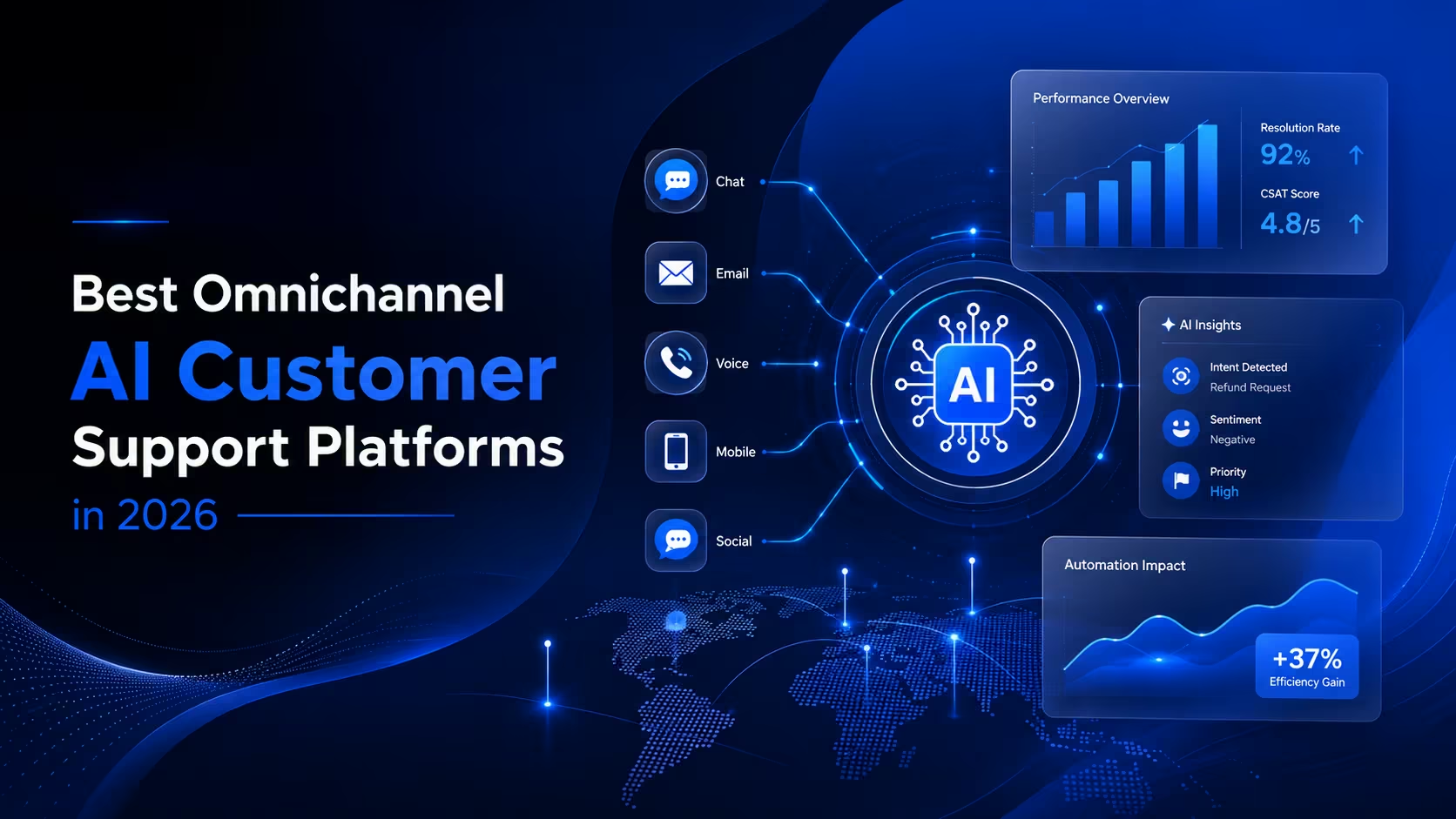
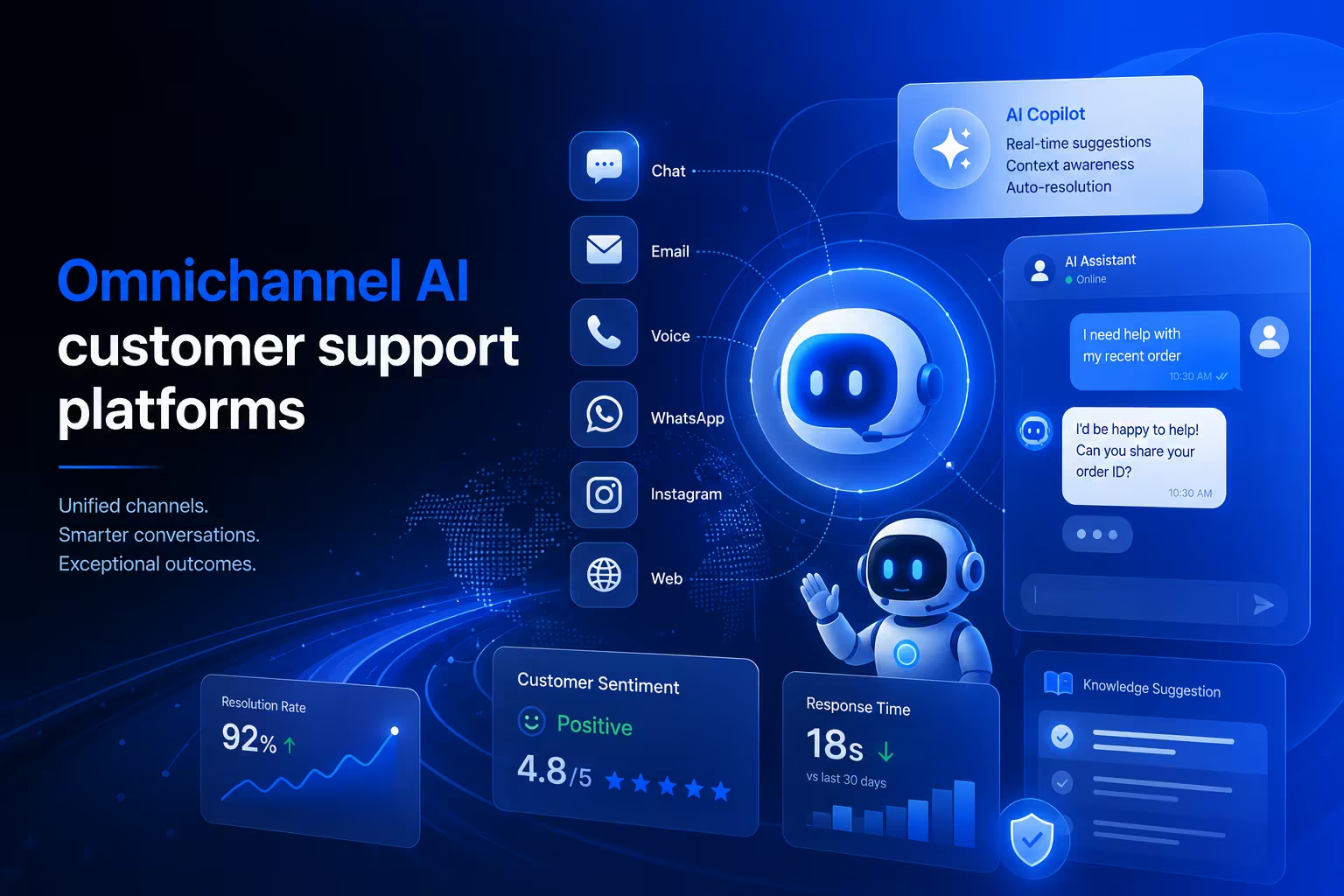
This fragmentation creates longer resolution times, frustrated customers, and overwhelmed support teams. As customer expectations rise and service volumes increase, enterprises are turning to omnichannel AI customer support platforms that unify conversations, automate repetitive tasks, and help agents deliver personalized experiences across every touchpoint.
The challenge isn't finding a platform with AI capabilities. It's identifying which solution can truly orchestrate customer journeys across voice, chat, email, messaging apps, and self-service channels while maintaining context throughout the interaction.
This guide compares the leading platforms in 2026, explains how enterprises should evaluate them, and highlights the capabilities that separate enterprise-ready solutions from basic support tools.
Why Omnichannel AI Customer Support Has Become a Strategic Priority
Customer behavior has fundamentally changed.
According to Gartner, customer service is rapidly moving toward automation-first experiences, while 51% of customers are willing to use AI assistants to interact with businesses on their behalf. Gartner also predicts that by 2028, customer service organizations will increasingly shift from reactive support to proactive experience orchestration.
Meanwhile, Salesforce's 2025 State of Service Report found that AI is expected to handle 50% of all customer service cases by 2027, up from 30% today.
These shifts are forcing organizations to rethink support technology. The question is no longer whether AI should be used in customer support. The question is whether your support platform can:
- Maintain context across channels
- Automate routine interactions
- Assist agents in real time
- Generate customer insights from every conversation
- Scale without increasing headcount proportionally
The Cost of Fragmented Support Systems
Organizations using separate tools for voice, email, live chat, WhatsApp, and social messaging often struggle with:
| Challenge | Business Impact |
|---|---|
| Customer context scattered across systems | Repeated explanations and lower CSAT |
| Manual ticket routing | Higher resolution times |
| Limited conversation visibility | Inconsistent service quality |
| Lack of AI assistance | Lower agent productivity |
| Separate reporting tools | Poor operational visibility |
| Channel silos | Broken customer journeys |
The result is a support organization focused on managing channels instead of delivering experiences.
See how Callveriq unifies support across every customer channel.
What Should You Look for in an Omnichannel AI Support Platform?
Many vendors claim to offer AI-powered support. However, enterprise buyers should evaluate solutions across six critical dimensions.
1. True Omnichannel Coverage
The platform should support:
- Voice
- Live chat
- SMS
- Social messaging
- Self-service portals
More importantly, customer context should move seamlessly across these channels.
2. Unified Customer Memory
Customer conversations should be accessible regardless of where the interaction began.
A customer who chatted yesterday should not need to repeat information during today's phone call.
3. AI Agent Assistance
Modern AI customer service platform solutions should provide:
- Real-time response suggestions
- Knowledge retrieval
- Next-best-action recommendations
- Automated summaries
- Compliance guidance
Gartner expects agent assist technologies to become one of the most valuable customer service technologies, with 73% of service organizations projected to implement agent assist capabilities.
4. Intelligent Automation
Look beyond chatbot automation.
Enterprise platforms should automate:
- Routing
- Escalations
- Ticket classification
- Workflow execution
- Follow-up actions
5. Conversation Intelligence
Every customer interaction should generate insights.
Leading platforms transform conversations into intelligence that improves operations, products, and the customer experience.
6. Enterprise Analytics
Executives need visibility into:
- Resolution rates
- Containment rates
- Agent performance
- Customer sentiment
- Service quality trends
Explore how Callveriq combines AI, automation, and conversation intelligence.
This blog is just the start.
Unlock the power of Callveriq’s AI with a live demo.

Best Omnichannel AI Customer Support Platforms in 2026
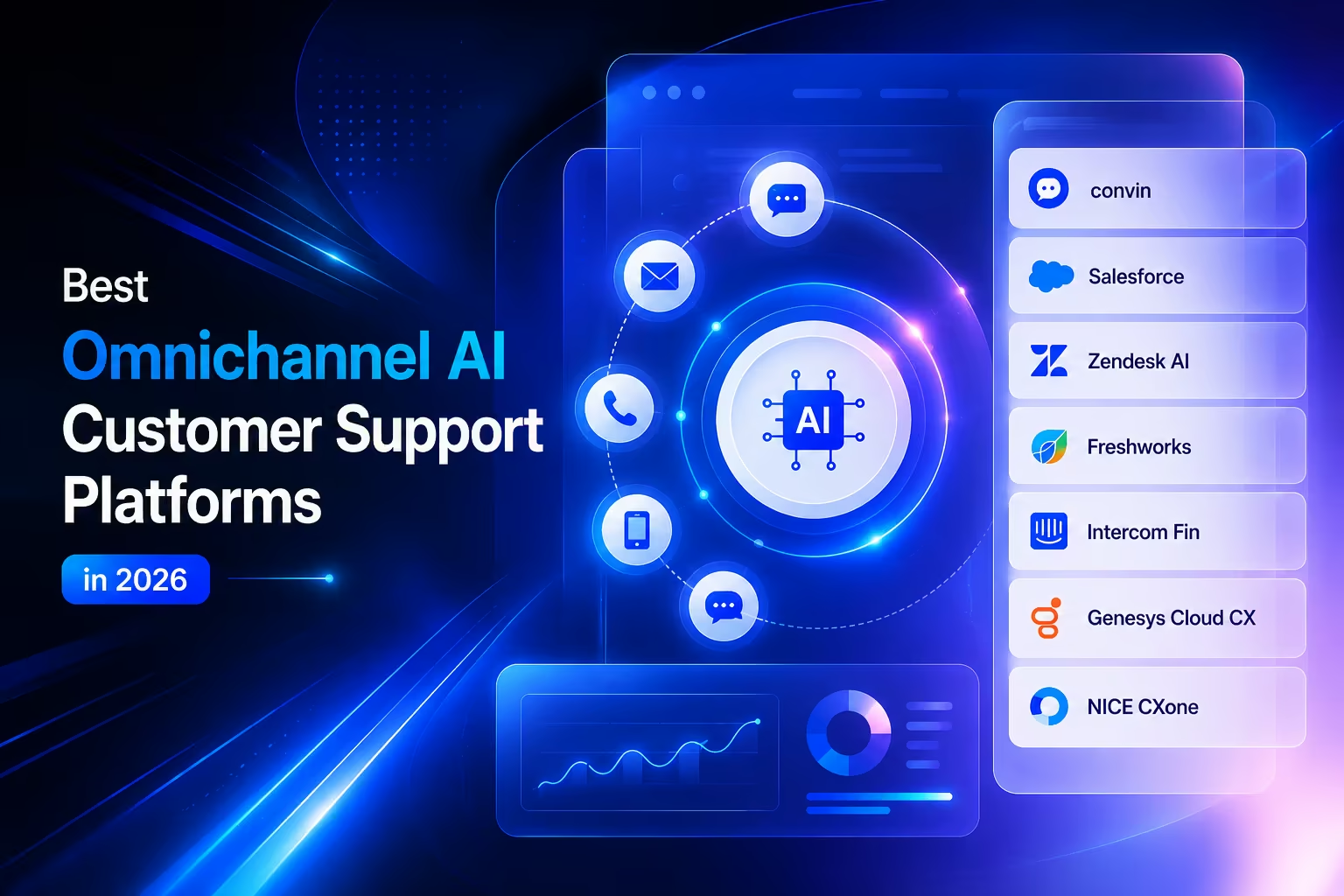
Not every platform delivers the same level of AI, automation, and omnichannel capabilities. While some focus on ticket management or chatbots, others provide a unified customer support ecosystem with voice AI, agent assistance, workflow automation, and conversation intelligence. Here's how the leading platforms compare in 2026.
Comparison Overview
| Platform | Voice AI | Email AI | Agent Assist | Conversation Intelligence | Best For | |
|---|---|---|---|---|---|---|
| Callveriq | Yes | Yes | Yes | Advanced | Advanced | Enterprise support operations |
| Salesforce Service Cloud | Yes | Yes | Yes | Advanced | Moderate | Salesforce ecosystem users |
| Zendesk AI | Limited | Yes | Yes | Moderate | Basic | Mid-market businesses |
| Freshworks | Limited | Yes | Yes | Moderate | Basic | Growing support teams |
| Intercom | No | Yes | Yes | Moderate | Limited | Digital-first businesses |
| Genesys Cloud CX | Advanced | Yes | Yes | Advanced | Advanced | Large contact centers |
| NICE CXone | Advanced | Yes | Yes | Advanced | Advanced | Enterprise contact centers |
1. Callveriq
Callveriq combines customer support automation, voice AI, agent assistance, quality monitoring, and conversation intelligence into a single platform.
Key Strengths
- Omnichannel support across voice, chat, WhatsApp, and email
- Real-time AI agent assistance
- Conversation intelligence engine
- Automated quality assurance
- Customer journey visibility
- Enterprise-grade analytics
Best For
Organizations are looking to consolidate support operations, automate service workflows, and generate actionable customer intelligence from conversations.
2. Salesforce Service Cloud
Salesforce continues to expand its AI capabilities through Einstein AI and Agentforce.
According to Salesforce's 2025 State of Service research, AI adoption has become the second-highest priority among service leaders, driven by increasing pressure to improve customer experience while controlling operational costs.
Key Strengths
- Strong CRM integration
- Extensive ecosystem
- AI-driven workflows
- Enterprise scalability
Limitations
- Complex implementation
- Higher total cost of ownership
- Requires significant customization
Best For
Organizations deeply invested in Salesforce infrastructure.
3. Zendesk AI
Zendesk has evolved from a ticketing platform into a broader customer service solution.
Key Strengths
- User-friendly interface
- Large integration marketplace
- AI-powered ticket management
Limitations
- Limited voice capabilities
- Less advanced conversation intelligence
- Requires add-ons for advanced analytics
Best For
Mid-sized customer support teams.
4. Freshworks
Freshworks offers AI-enhanced support through Freddy AI.
Key Strengths
- Easy deployment
- Competitive pricing
- Strong omnichannel capabilities
Limitations
- Limited enterprise analytics
- Less sophisticated AI automation
Best For
Fast-growing organizations seeking operational efficiency.
5. Intercom Fin
Intercom has positioned Fin as an AI-first support solution.
Industry discussions around AI-driven support increasingly focus on autonomous resolution. Recent market attention has highlighted platforms capable of resolving a significant percentage of customer inquiries without human intervention.
Key Strengths
- Strong AI chatbot experience
- Fast deployment
- Knowledge-base automation
Limitations
- Primarily digital channels
- Limited voice-first capabilities
Best For
Digital-native companies.
6. Genesys Cloud CX
Genesys remains a leader in enterprise contact center transformation.
Key Strengths
- Advanced routing
- Workforce optimization
- Voice and digital integration
- Enterprise scalability
Limitations
- Complex deployments
- Premium pricing
Best For
Large enterprises with complex service environments.
7. NICE CXone
NICE combines contact center operations, analytics, and AI automation.
Key Strengths
- Mature contact center capabilities
- AI-powered routing
- Strong analytics
Limitations
- Longer implementation cycles
- High operational complexity
Best For
Global customer service organizations.
See Callveriq's AI customer support in action.
How to Compare Omnichannel AI Support Platforms for Enterprise
Choosing an omnichannel AI support platform requires more than comparing features. The right platform should improve customer experience, automate workflows, deliver measurable business outcomes, and scale with enterprise needs. Use the evaluation framework below to compare vendors based on the capabilities that matter most.
| Evaluation Area | Questions to Ask |
|---|---|
| Customer Context | Is customer history unified across channels? |
| Automation | Can workflows be automated end-to-end? |
| AI Assistance | Does AI help agents in real time? |
| Voice AI | Can the platform automate voice interactions? |
| Analytics | Are conversation insights actionable? |
| Scalability | Can it support enterprise volumes? |
| Governance | Does it support compliance and security requirements? |
| Reporting | Can executives measure ROI easily? |
Questions Every Vendor Should Answer
- What percentage of interactions can AI resolve?
- How does customer context persist across channels?
- How quickly can workflows be automated?
- How is quality monitored at scale?
- What reporting is available for executives?
- How does the platform support voice, WhatsApp, email, and chat together?
Compare AI support platforms with Callveriq.
This is increasingly becoming a critical enterprise requirement.
Many vendors offer multiple channels but rely on separate modules, disconnected reporting, or fragmented customer histories.
The strongest platforms provide:
- Unified customer memory
- Shared conversation history
- AI automation across channels
- Consistent reporting
- Real-time agent assistance
Research published in 2026 on large-scale customer support AI deployments highlights that context engineering, unified evaluation frameworks, and integrated workflows are becoming essential for delivering production-grade AI support experiences.
This is why enterprises are moving away from isolated chatbot deployments and toward integrated AI customer service platform ecosystems.
See how Callveriq unifies voice, messaging, email, and AI assistance.
What This Means for Your Business
The market for omnichannel customer support technology is rapidly shifting from channel management to experience orchestration. Enterprises no longer need separate systems for voice, email, WhatsApp, chat, quality monitoring, analytics, and AI automation. They need a unified platform that connects every interaction, preserves customer context, and continuously improves service performance through intelligence and automation.
The best omnichannel AI customer support platforms in 2026 are not simply deploying AI to answer tickets faster. They are using AI to create connected customer journeys, empower agents with real-time guidance, automate operational workflows, and generate insights that drive business decisions. As customer expectations continue to rise and support volumes grow, organizations that invest in a comprehensive AI customer service platform will be better positioned to deliver faster resolutions, lower operational costs, and more consistent customer experiences across every channel.
FAQs
1. Can an omnichannel AI customer support platform integrate with existing CRM and helpdesk software?
Yes. Most enterprise platforms integrate with CRMs, helpdesks, and business tools to unify customer data and streamline support workflows.
2. How long does it take to implement an AI customer service platform?
Implementation can take anywhere from a few weeks to a few months, depending on integrations, customization, and deployment complexity.
3. How does AI improve agent productivity beyond chatbots?
AI assists agents with response suggestions, conversation summaries, knowledge retrieval, and workflow automation, reducing manual effort and handling time.
4. Is an omnichannel AI customer support platform suitable for regulated industries?
Yes. Many platforms offer enterprise-grade security, compliance monitoring, encryption, and audit logs for regulated sectors.
5. What metrics should businesses track after implementing an AI customer support platform?
Track metrics like first contact resolution, average handling time, CSAT, automation rate, and agent productivity to measure business impact.