


If you're reading this, you've likely already accepted that manual SDR work,endless follow-ups, inconsistent qualification, reps burning out on repetitive outreach,isn't scaling the way your pipeline needs it to. The real question at this stage isn't "what is an AI SDR" in the abstract; it's whether one can actually replace what your human SDRs are doing today, where it falls short, and whether the economics genuinely work out. An AI SDR takes over the repeatable layer of sales development,reaching leads on the right channel, qualifying them consistently, and following up without fail,while leaving judgment-heavy work to your team. This blog walks through what to actually evaluate: how it compares to a traditional SDR, how it decides where and when to reach a lead, which tasks you can safely hand off versus keep in-house, and what it really costs against a human hire.
See how AI SDRs qualify leads
Why Are Teams Choosing AI SDRs?
Most teams don't switch to an AI SDR because the concept is new,they switch because their current SDR motion is hitting a ceiling. Leads are getting missed, follow-ups are inconsistent, and headcount can't grow as fast as the lead volume does.
What An AI SDR Actually Replaces
An AI SDR takes over the parts of the SDR role that are repeatable and rules-based, not the parts that require judgment:
- Reaching every lead in the list, not just the top-priority ones a human has time for
- Following up on schedule, every time, without leads going cold from bandwidth limits
- Applying identical qualification logic to lead 1 and lead 10,000
What's Driving The Shift Right Now
Omnichannel AI has reached the point where voice, chat, and messaging can carry the same context and consistency a trained human rep used to provide. This is the same shift examined in Callveriq's breakdown of AI agents for sales, where automated qualification and follow-up aren't treated as a nice-to-have layer but as the baseline a modern sales motion is built on.
Explore AI SDR use cases
How Does It Decide Where To Reach Leads?
Before adopting an AI SDR, it's worth understanding exactly how it makes channel and timing decisions, because this is where most of the qualification quality actually comes from. A tool that just blasts the same message across every channel isn't really doing omnichannel outreach; it's doing single-channel outreach on repeat. The real value shows up in how the system weighs signals and adapts its next move for each individual lead, in real time, without a human telling it what to do next.
Choosing The Right Channel And Moment
The AI SDR doesn't treat every channel the same. It continuously reads engagement history and routes each lead based on what's actually working for them, not a fixed sequence applied to everyone:
- A lead who's ignored two emails but opened a WhatsApp message gets moved to WhatsApp
- A high-intent lead who just filled a form gets an immediate voice call instead of sitting in an email queue
- A lead active mostly in the evening gets follow-ups scheduled for that window, not 10 AM
- A lead who clicked a pricing link but didn't reply gets a shorter, more direct follow-up instead of a generic nudge
- A lead who's gone quiet across every channel for several days gets deprioritized instead of repeatedly re-contacted
This kind of channel-switching also extends to tone and pacing. A lead early in the funnel might get a soft, informational touch, while one who's already engaged twice gets a more direct, meeting-focused message, the system adjusts both the medium and the approach based on where that specific lead actually is.
How Qualification Actually Happens
Instead of static forms, the AI SDR asks qualifying questions conversationally, budget, timeline, decision-making authority, and scores the lead in real time based on how they respond, not just whether they respond. A one-word "maybe" and a detailed explanation of urgency get scored very differently, even if both count as a "reply" on paper.
This mirrors the approach in Callveriq's guide to AI-driven lead qualification, where qualification happens inside the conversation itself rather than a separate form-filling step. The AI doesn't wait for a lead to fill out five fields before deciding whether they're worth pursuing; it builds that picture turn by turn, updating the lead's score after every exchange instead of at one fixed checkpoint.
This same conversational scoring logic extends across both inbound and outbound motions, as covered in Callveriq's comparison of inbound and outbound AI-powered sales, worth checking before deciding which one to deploy first. Whether the lead reached out first or was contacted cold, the qualifying questions and scoring criteria stay consistent, which is what keeps the handoff to human reps predictable regardless of which channel or motion originated the conversation.
See real-time lead scoring
This blog is just the start.
Unlock the power of Callveriq’s AI with a live demo.

What Should You Automate Vs Keep?
This is the evaluation question that actually determines whether an AI SDR rollout succeeds: not "can AI do this," but "should it, given what's at stake."
Safe To Hand Off Entirely
- Initial outreach across voice, email, and WhatsApp
- Follow-up sequencing and reminders
- Basic qualifying questions (budget, timeline, fit)
- CRM logging and lead scoring
- Scheduling meetings once interest is confirmed
Better Left With A Human
- Negotiating complex, high-value deals
- Reading emotional or political nuance in enterprise buying committees
- Building long-term relationship trust with strategic accounts
- Handling objections that fall outside a defined playbook
This is the same split covered in Callveriq's look at inbound sales and conversation intelligence, where AI is positioned to own volume and consistency while humans stay in the loop for anything that carries real deal risk. The framing isn't about how capable the AI is in isolation, it's about which tasks fail safely if the AI gets them slightly wrong, and which ones don't.
Outreach timing, follow-up cadence, and basic qualification questions fail safely: worst case, a lead gets a slightly mistimed message or an extra follow-up. Reading a buying committee's internal politics or negotiating final terms on a six-figure deal doesn't fail safely, a wrong move there can cost the deal outright. That asymmetry is the real basis for deciding what to automate, not a general sense of how "smart" the AI seems in a demo.
Running your own team through this checklist before rollout is what separates a rollout that sticks from one that gets rolled back within a quarter. Map each task your SDRs currently do against this same fail-safe test, and the automate-versus-keep line usually draws itself.
Compare AI vs human tasks
Is It Cheaper Than A Human SDR?
This is usually the deciding factor once the capability question is settled: does an AI SDR genuinely cost less, or is it just a different set of costs dressed up as savings?
What A Human SDR Actually Costs You
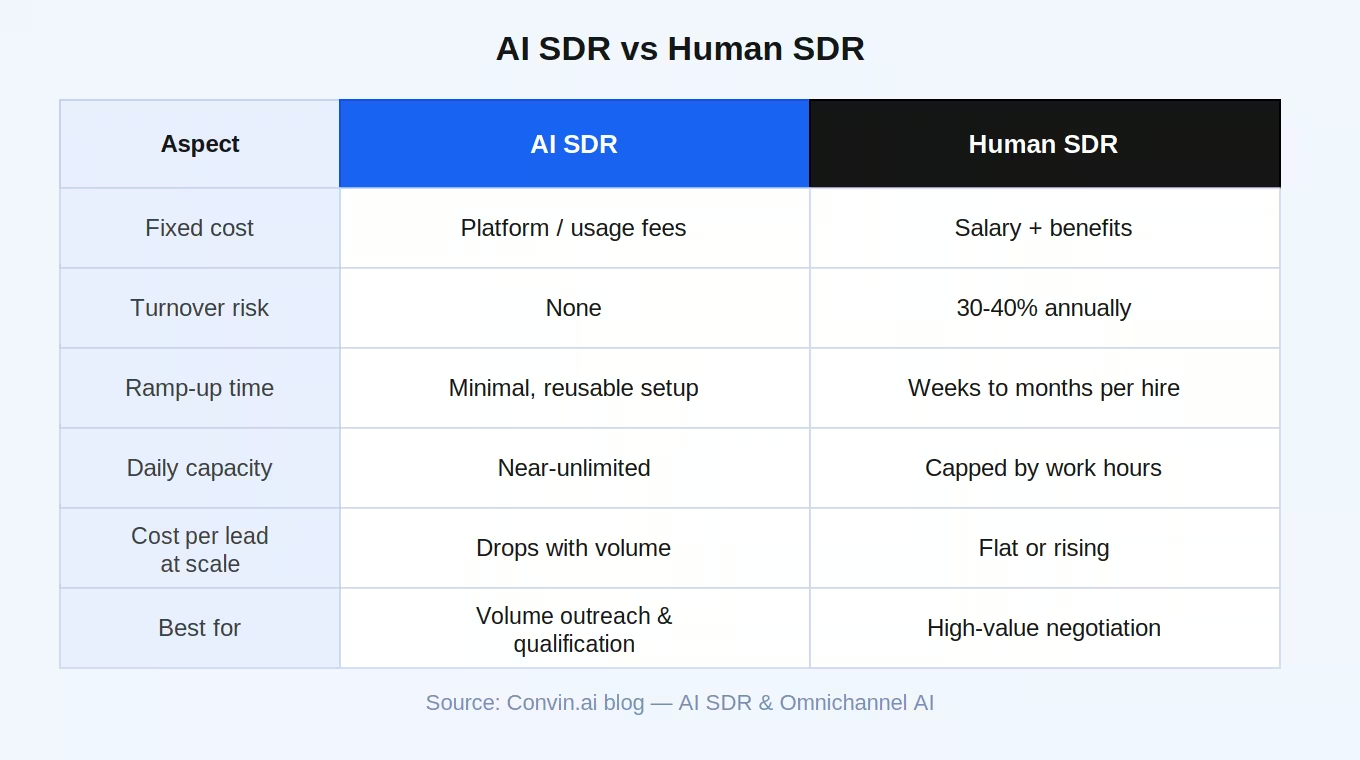
A fully loaded human SDR isn't just base salary,factor in benefits, management overhead, tools, ramp-up time, and the 30-40% annual turnover common in SDR roles. For B2C outbound at volume, this cost multiplies quickly since more reps are needed to cover more leads.
What An AI SDR Actually Costs You
An AI SDR's cost structure looks different: platform or usage-based fees, integration setup, and ongoing monitoring,but no salary, no turnover, and no ramp-up for each new hire. At B2C outbound volumes, cost per qualified lead typically drops as volume increases, while a human team's cost per lead stays flat or rises as more reps get added:
- Human SDR: higher fixed cost per rep, capped daily capacity, turnover risk
- AI SDR: lower marginal cost per lead, near-unlimited capacity, consistent qualification quality
The right call usually isn't "replace the whole team",it's matching AI to the volume-heavy parts of outbound while keeping a smaller human team for the deals worth the extra cost.
Calculate your AI SDR savings
Making The Call
The decision isn't really AI versus human SDRs,it's figuring out which parts of your current outbound motion are costing you leads through inconsistency, and letting AI take that layer over. Run the comparison against your own lead volume and deal complexity, and the right split between AI and human effort usually becomes obvious fast.
Get started with Callveriq’s solution today
FAQs
1. What is an AI SDR? An AI SDR is software that automates prospecting, outreach, qualification, and follow-up,the core repeatable tasks of a traditional SDR.
2. Can an AI SDR fully replace a human SDR? Not entirely. It handles outreach and qualification well but still needs humans for complex negotiation and relationship-building.
3. How does an AI SDR decide which channel to use? It uses past engagement data,response rates, time zone, and channel activity,to pick voice, WhatsApp, or email for each lead.
4. Is an AI SDR cheaper than a human SDR? Often yes at scale, since it has no salary or turnover cost, though platform and setup costs still apply.
5. Do small B2C teams benefit from an AI SDR? Yes, especially for handling outreach volume and follow-up consistency that a small human team can't sustain alone.