

Most conversational AI projects don't fail because the technology is weak. They fail because teams never define what success looks like.
A customer support leader wants lower resolution costs. A CX leader wants better customer satisfaction. A CFO wants a clear payback period. Meanwhile, vendors promise automation, productivity gains, and cost savings without connecting them to business outcomes.
This is why conversational AI ROI has become the most important buying metric in customer service technology. Buyers no longer ask whether AI works. They ask how much value it creates, how quickly it pays back, and which metrics improve after deployment.
In this guide, we'll break down conversational AI ROI benchmarks, real business outcomes, payback expectations, and a practical framework for building a conversational AI business case that stands up to executive scrutiny.
Measure conversational AI ROI with Callveriq.
What Is Conversational AI ROI?
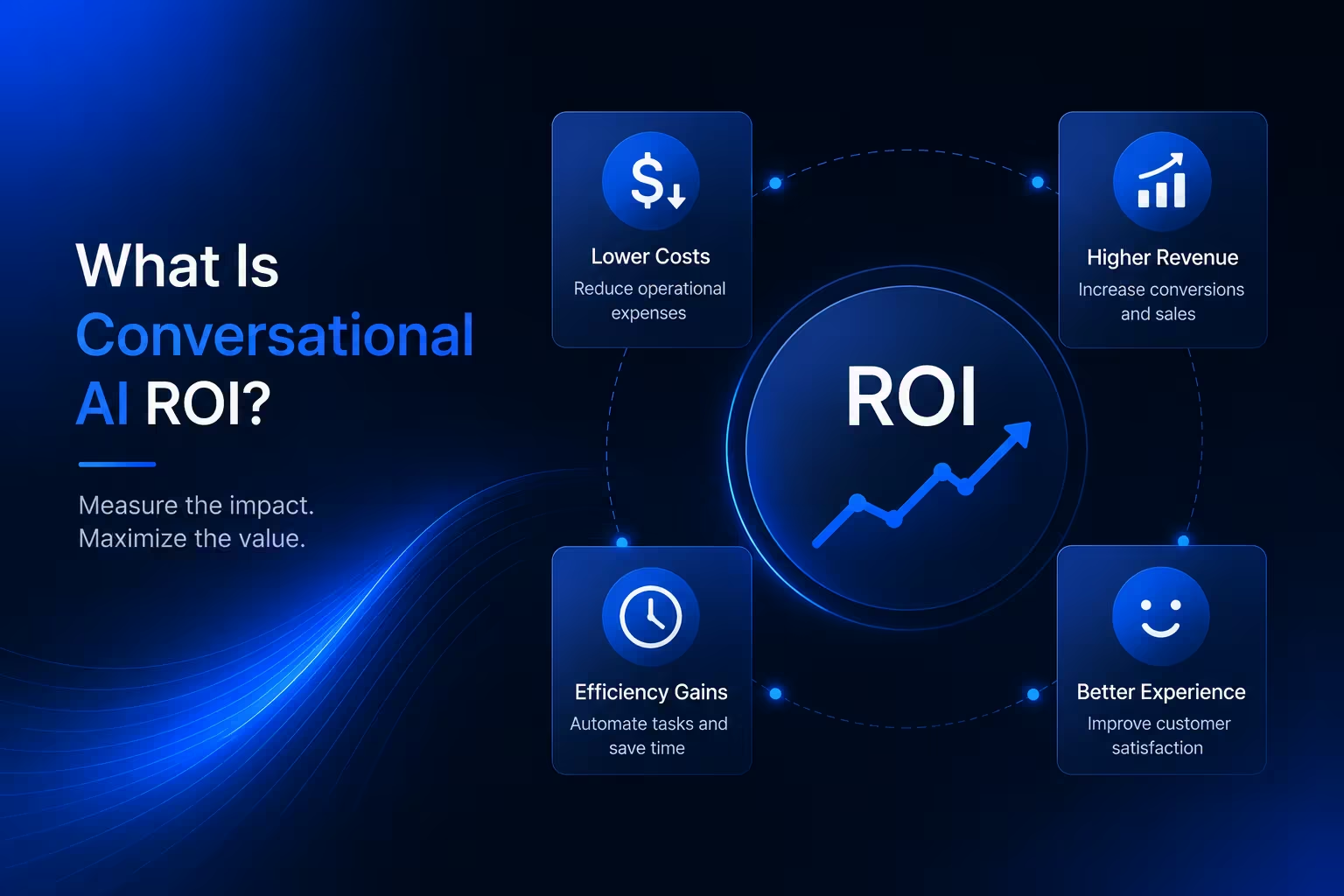
Conversational AI ROI measures the business value generated from AI-powered customer interactions compared to the total investment required to deploy and maintain the solution.
Basic ROI Formula
For customer service teams, ROI typically comes from:
- Reduced support costs
- Higher agent productivity
- Faster response times
- Increased self-service adoption
- Improved CSAT
- Reduced attrition
- Higher conversion rates from customer conversations
The most successful organizations evaluate ROI across both cost reduction and revenue impact.
See how Callveriq connects AI performance to business outcomes
Conversational AI ROI Benchmarks: What Results Are Organizations Seeing?
While results vary by industry and maturity, several patterns consistently emerge across deployments.
Typical Business Outcomes
According to Salesforce's 2025 State of Service Report, AI is expected to handle half of all customer service cases by 2027, up from approximately 30% today. This reflects how quickly AI-driven service operations are becoming mainstream.
Gartner predicts agentic AI will autonomously resolve 80% of common customer service issues by 2029 and reduce operational costs by up to 30% for many organizations.
Example ROI Scenario
For organizations operating large contact centers, even modest improvements create significant financial impact.
Benchmark your support operations against Callveriq customers.
This blog is just the start.
Unlock the power of Callveriq’s AI with a live demo.

What Metrics Improve After Deploying Conversational AI?
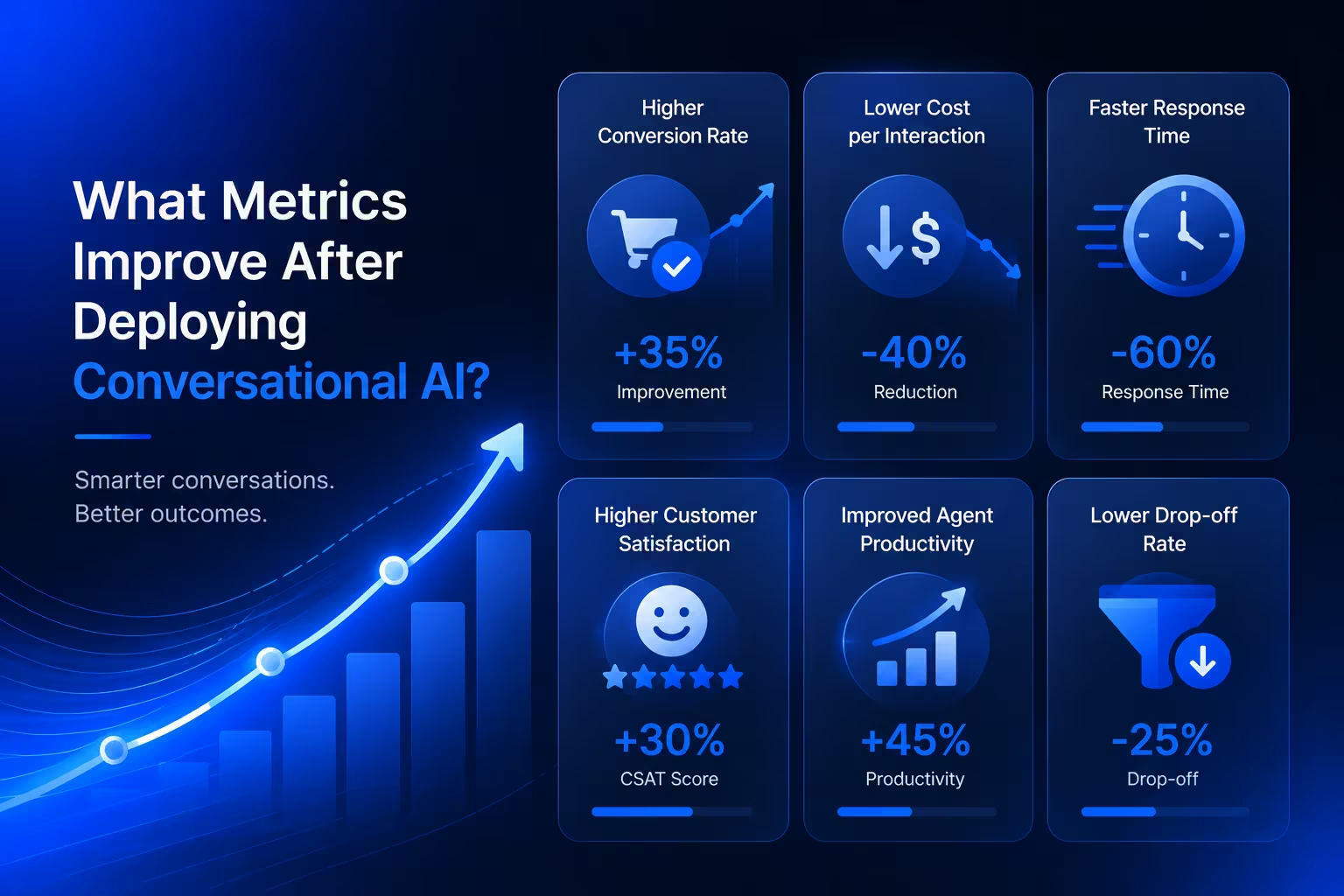
Many buyers focus exclusively on automation rates. That is a mistake. The strongest conversational AI business case includes operational, customer experience, and financial metrics.
Many organizations measure conversational AI success through automation rates alone, but that provides only a partial view of business impact. A comprehensive conversational AI ROI strategy should track operational efficiency, customer experience, and financial performance together.
Operational Metrics
These metrics show how AI improves service delivery and workforce productivity:
- Average Handle Time (AHT) to measure efficiency gains
- Resolution Rate to track successful issue resolution
- Agent Utilization to evaluate productivity improvements
- Transfer Rate to assess AI effectiveness and escalation needs
- Queue Length to monitor service efficiency and workload distribution
Customer Experience Metrics
These indicators help determine whether AI is improving customer interactions:
- Customer Satisfaction (CSAT) to measure overall experience
- Net Promoter Score (NPS) to gauge customer loyalty
- Customer Effort Score (CES) to understand resolution ease
- Response Time to evaluate service speed and accessibility
Financial Metrics
These metrics connect conversational AI directly to business outcomes:
- Cost Per Resolution to measure cost savings
- Revenue Per Interaction to identify sales impact
- Customer Retention to evaluate long-term business value
- Customer Lifetime Value (CLV) to assess revenue growth potential
Organizations that monitor all three categories are far more likely to build a strong conversational AI business case and accurately demonstrate customer service AI ROI than those focused solely on automation rates.
Track every ROI metric with Callveriq analytics.
How to Build a Conversational AI Business Case
Most executive teams approve budgets when three questions are answered clearly:
- What problem are we solving?
- What financial impact will it create?
- How quickly will we see results?
Step 1: Define Current Costs
Calculate:
- Support headcount costs
- Outsourcing costs
- Technology costs
- Escalation costs
- Customer churn costs
Step 2: Estimate AI Impact
- Model multiple scenarios.
Avoid assuming perfect automation.
Step 3: Calculate Annual Benefits
Include:
- Reduced ticket handling costs
- Improved agent productivity
- Faster onboarding
- Reduced attrition
- Revenue influence
Step 4: Calculate Total Investment
Include:
- Platform licensing
- Integration
- Training
- Maintenance
- Change management
Step 5: Present ROI and Payback
Example Conversational AI ROI Calculation
- Total Investment: $150,000
- Annual Business Benefit: $600,000
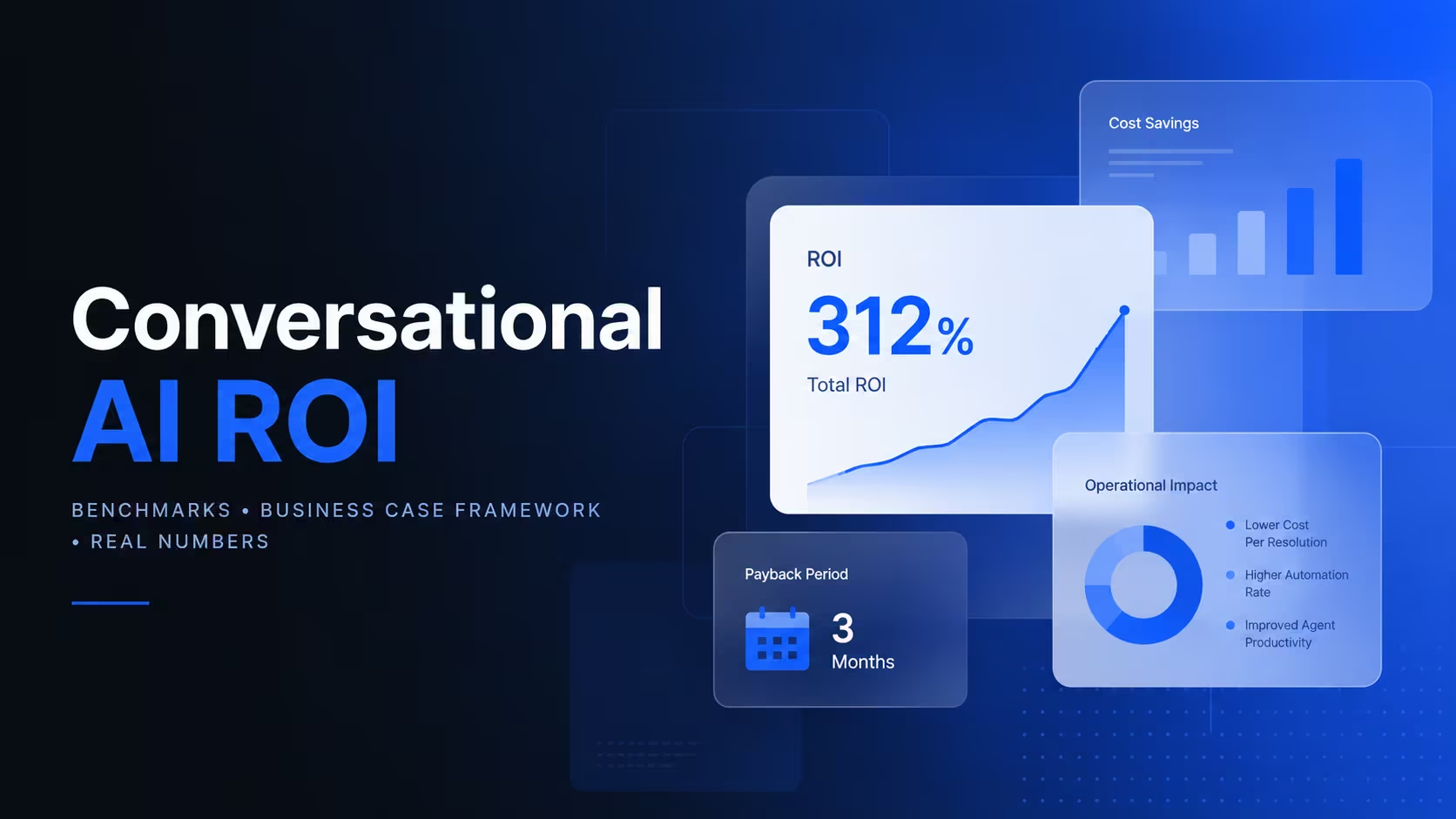
- ROI Achieved: 300%
- Payback Period: 3 months
In this scenario, a $150,000 conversational AI investment generates $600,000 in annual value through cost savings, productivity gains, and improved customer outcomes. The organization recovers its investment within three months and continues realizing returns throughout the year.
What Is the Typical Payback Period for Conversational AI?
The payback period depends on ticket volume, labor costs, and automation success.
Typical Payback Expectations
The highest-performing deployments reach payback faster because they focus on high-volume repetitive interactions first.
Examples include:
- Order status requests
- Appointment scheduling
- Billing inquiries
- Password resets
- FAQs
Organizations that start with these use cases generally realize value significantly faster than teams attempting broad enterprise-wide automation from day one.
Discover the fastest path to AI payback with Callveriq.
Why Some Conversational AI Projects Deliver Poor ROI
Not every implementation succeeds. Many AI projects fail because teams buy technology before defining business outcomes.
Common ROI Killers
Conversational AI can deliver significant business value, but only when it is implemented with clear goals, strong data, and the right use cases. Many organizations struggle to realize expected returns because of a few avoidable mistakes:
- No baseline metrics: Without tracking metrics such as ticket volume, handle time, resolution rate, or support costs before deployment, it becomes difficult to prove ROI after implementation.
- Poor knowledge base quality: AI is only as effective as the information it can access. Outdated, incomplete, or inconsistent knowledge sources often lead to inaccurate responses and lower customer satisfaction.
- Limited integrations: When conversational AI is not connected to CRM, ticketing, billing, or other business systems, it can answer questions but cannot complete actions, limiting automation potential.
- Low adoption across teams and customers: Even the best AI solution will struggle to generate value if agents, customers, or business teams do not actively use it as part of their workflows.
- Choosing the wrong use cases: Starting with highly complex or low-volume interactions often delays results. Organizations typically see faster ROI when they focus first on repetitive, high-volume customer requests.
Addressing these challenges early helps organizations accelerate deployment success, improve adoption, and achieve stronger conversational AI ROI in a shorter timeframe.
Gartner notes that organizations often overestimate immediate labor savings from AI while underestimating the operational changes required for success.
The best-performing organizations redesign workflows around AI rather than simply layering AI on top of existing processes.
Avoid costly AI mistakes with Callveriq experts.
Industry Benchmarks: Where ROI Is Highest
Ecommerce
Common gains:
- Cart recovery
- Order tracking automation
- Return management
BFSI
Common gains:
- Faster customer verification
- Loan servicing automation
- Reduced call volumes
Healthcare
Common gains:
- Appointment management
- Patient communication
- Reduced administrative burden
Telecom
Common gains:
- Billing support
- Plan upgrades
- Service troubleshooting
These industries typically see the fastest ROI because of their large volumes of repetitive customer interactions.
Explore industry-specific ROI opportunities with Callveriq.
What This Means For Your Business
The conversation around conversational AI has shifted. Buyers are no longer impressed by automation percentages, chatbot volumes, or AI adoption headlines. They want measurable business impact.
The organizations seeing the strongest conversational AI ROI start with a clear business objective, establish baseline metrics, and focus on high-volume customer interactions where automation creates immediate value. They measure outcomes across operational efficiency, customer experience, and financial performance rather than relying on a single metric.
As customer service becomes increasingly AI-driven, the competitive advantage will not come from deploying conversational AI. It will come from deploying it with accountability, measurement, and a framework that ties every interaction back to business results. If your team can prove cost savings, faster resolutions, improved customer satisfaction, and a clear payback period, conversational AI stops being a technology investment and becomes a growth investment.
Book your demo with Callveriq to measure conversational AI ROI.
FAQs
1. How do CFOs evaluate conversational AI investments?
Most CFOs evaluate conversational AI based on ROI, payback period, cost savings, and customer retention impact, with a strong focus on measurable financial outcomes.
2. Can conversational AI increase revenue, not just reduce costs?
Yes. Conversational AI can improve lead qualification, conversion rates, upsell opportunities, and customer retention, creating direct revenue impact beyond operational savings.
3. What departments benefit most from conversational AI ROI?
Customer support, sales, collections, onboarding, and customer success teams often generate the highest returns because they handle large volumes of repetitive interactions.
4. How much data is required before calculating conversational AI ROI?
Most organizations need at least three to six months of baseline operational data, including ticket volume, handle time, staffing costs, and customer satisfaction metrics.
5. How often should conversational AI ROI be measured?
Leading organizations track ROI monthly and conduct quarterly reviews to assess automation performance, customer experience improvements, and financial impact.