

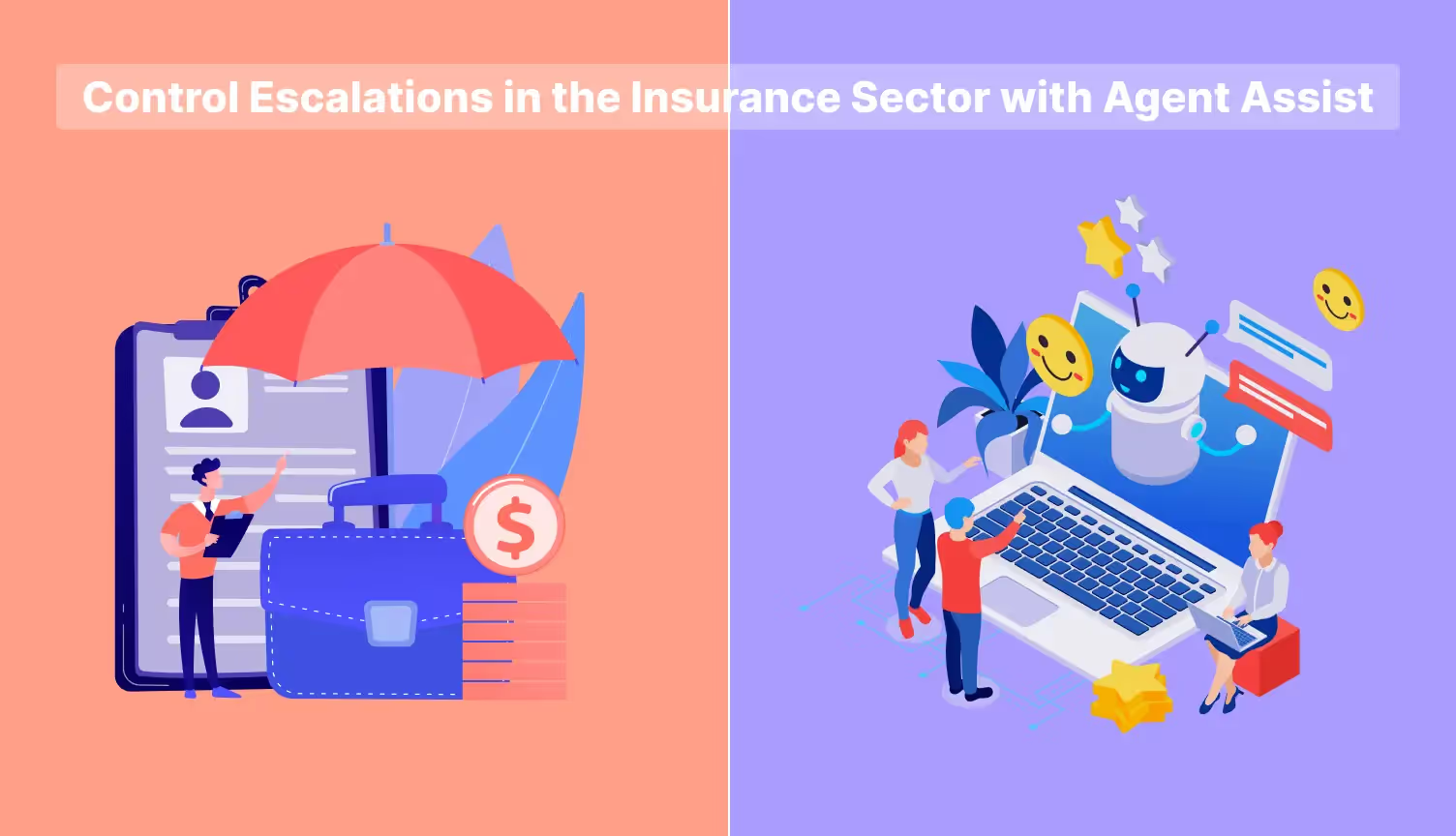
Insurance call center escalations are expensive signals that something in the front-line service experience has broken down. Every escalation costs 4–6x the time of a resolved first-contact interaction, generates negative CSAT, and carries a non-trivial probability of becoming an IGMS complaint. In an industry where IRDAI publishes complaint ratios by insurer — and where corporate buyers, bancassurance partners, and aggregators increasingly reference those ratios — escalation management is both a cost problem and a reputation problem.
The most effective approach to insurance call center escalations is not handling them better after they happen — it's preventing them before they do. Most escalations in Indian insurance operations are predictable, traceable to a specific failure point in the front-line interaction, and preventable with the right agent support and call monitoring infrastructure.
This guide maps the most common insurance call center escalation triggers in India, the prevention framework, and the operational changes that reduce escalation rates measurably.
IGMS Escalation Cost
An escalated call that reaches IGMS takes an average of 15–30 business days to resolve, involves compliance team time, and generates a formal record that IRDAI reviews in aggregate. Preventing one IGMS complaint is worth far more than the cost of the front-line interaction that would have resolved the issue.
The 7 Most Common Insurance Call Center Escalation Triggers
| Escalation trigger | Root cause | Prevention lever |
|---|---|---|
| Claim rejection — policyholder disputes | Agent gave inaccurate coverage information at point of sale or service; disclosure not made adequately | IRDAI-compliant sales monitoring; accurate coverage explanation scripts at service touchpoints |
| Renewal premium increased without adequate notice | Policyholder not informed of premium change before renewal; renewal process not explained clearly | Proactive renewal communications that explicitly state the new premium vs prior year |
| Long claim resolution time | Policyholder not updated on claim status; expectations not set at first contact | Proactive claim status updates via AI outbound; SLA setting on first contact |
| Agent gave incorrect policy information | Agent unsure of product details; no real-time knowledge support available during call | AI knowledge surfacing during live calls; product information accessible to agents in real time |
| Policyholder feels misled about product benefits | Benefits overstated at sale or renewal — classic misselling pattern | 100% call monitoring; real-time flagging when agent language overstates benefits |
| Long hold times / inability to reach agent | High call volume; understaffed IVR routing | AI self-service handling for routine queries; smart routing for complex escalation-prone calls |
| Repeat contact for same unresolved issue | First agent didn't resolve the issue or document it correctly for the next interaction | Auto CRM logging after every call; resolution tracking; escalation flags on repeat contacts |
How Callveriq Reduces Insurance Call Center Escalations
The majority of insurance call center escalations are preventable — they trace back to a front-line conversation where something was said incorrectly, incompletely, or in a way the policyholder misunderstood. Callveriq's omnichannel AI sales agent addresses escalation prevention at the source: the live conversation.
| Escalation source | Callveriq prevention mechanism |
|---|---|
| Agent misstates coverage or benefit | Real-time alert when agent language deviates from approved product script; supervisor notified before call ends |
| Disclosure not made — creates misselling complaint later | AI monitors for mandatory IRDAI disclosures on every call; flags and logs any omission in real time |
| Policyholder not informed of claim status | AI-triggered proactive claim status update calls at key milestones — no policyholder needs to call to ask |
| Agent documents call incorrectly — next agent has wrong context | Automatic structured CRM entry after every call — no manual logging; resolution status captured |
| Repeat caller not recognised as escalation risk | AI flags when a caller has contacted more than twice on the same issue — automatic priority routing to senior agent |
| Renewal premium increase not communicated | AI renewal scripts explicitly state premium change vs prior year in every outbound renewal call |
IRDAI Compliance Link
IRDAI requires insurers to resolve policyholder grievances within 15 days and report unresolved grievances to the Authority. Escalations that reach IGMS are counted against the insurer's public complaint ratio. Proactive call monitoring that catches issues before they become complaints is the most direct way to protect this ratio.
This blog is just the start.
Unlock the power of Callveriq’s AI with a live demo.

The Escalation Prevention Framework: 3 Layers
Layer 1: Front-Line Quality (Preventing Escalation at Source)
The most effective escalation prevention happens during the original customer interaction — before the policyholder hangs up dissatisfied. This requires two things: agents who have accurate product knowledge accessible in real time, and 100% monitoring of every call for disclosure compliance and benefit accuracy. AI-powered real-time monitoring is the structural solution. When 100% of calls are reviewed — not 2–3% — the probability of a disclosure failure or benefit misstatement going uncorrected drops dramatically. Callveriq's AI flags issues during the call, not after, giving supervisors time to intervene before the policyholder leaves the interaction with a wrong impression.
Layer 2: First-Contact Resolution (Containing Escalation Potential)
Many escalations are caused not by the original interaction going badly, but by a second or third contact where the policyholder's issue still isn't resolved. First-contact resolution (FCR) is the primary metric to track: the percentage of policyholder contacts where the issue is fully resolved without a callback, transfer, or follow-up needed.
| FCR improvement lever | What it requires |
|---|---|
| Agent empowerment to resolve without transfer | Clear policy on what agents can resolve vs escalate; supervisor availability for live consultation |
| CRM context available at call start | Agent sees full policyholder history — prior contacts, claim status, renewal date — before saying hello |
| Real-time product knowledge access | AI knowledge surfacing during live call so agent doesn't need to put policyholder on hold for information |
| Accurate SLA setting on first contact | Agent commits to a specific resolution date and time — policyholder doesn't need to call back to check |
Layer 3: Proactive Service (Eliminating the Need for the Call)
The highest-leverage escalation prevention is making the escalation-triggering call unnecessary. A policyholder who receives a proactive claim status update doesn't need to call and ask. A policyholder who receives a clear renewal notice with the new premium amount doesn't call to dispute an unexpected charge. AI-powered proactive outreach — claim updates, renewal notices, policy change notifications — reduces inbound escalation volume by addressing information needs before they become complaints.
Measuring Escalation Performance: Metrics That Matter
| Metric | Definition | Target benchmark | Primary driver |
|---|---|---|---|
| Escalation rate | % of total calls that escalate to supervisor or specialist | Under 5% | Front-line agent empowerment and real-time support |
| IGMS complaint rate | Complaints per 10,000 policies (IRDAI published metric) | Varies — aim for industry top quartile | 100% call monitoring; misselling prevention |
| First contact resolution (FCR) | % of contacts fully resolved without callback | 75–85% | Agent knowledge access; CRM context; SLA setting |
| Repeat contact rate | % of policyholders who contact more than twice on same issue | Under 10% | CRM documentation; escalation flagging on repeat contacts |
| Average handle time on escalations | Average call duration for escalated calls | Reducing trend over time | Better front-line resolution; smarter escalation routing |
Frequently Asked Questions
What are the most common insurance call center escalations in India?
The most common triggers are claim rejection disputes, unexpected premium increases at renewal, long claim resolution times without status updates, agents providing incorrect policy information, and policyholders who feel product benefits were misrepresented at the point of sale. The majority trace back to a front-line conversation failure — either a disclosure not made, information stated incorrectly, or an expectation set that the product couldn't meet.
How can insurance call centers reduce escalation rates?
The three highest-impact interventions are: (1) 100% call monitoring to catch disclosure failures and benefit misstatements before they become complaints; (2) automatic CRM logging after every call so every agent has full context on a policyholder's history and prior contact; and (3) proactive outreach on claim status and renewal changes that removes the information asymmetry that drives most inbound escalation calls.
How does AI reduce insurance call center escalations?
Callveriq's AI reduces escalations at three levels: real-time monitoring that catches compliance failures during the live call; automatic CRM documentation that ensures every subsequent agent has full context; and proactive outbound calls on claim status and renewal changes that prevent the escalation-triggering inbound call from happening in the first place. Insurers deploying 100% AI call monitoring report 50–60% reductions in IGMS complaint rates within six months.
About Callveriq
Callveriq's omnichannel AI sales agent is deployed in Indian insurance call centers for real-time compliance monitoring, automatic CRM logging, proactive claim status outreach, and escalation detection on repeat contacts. Learn more at callveriq.com.