

Managing repetitive tasks, such as answering customer inquiries and scheduling appointments, can be overwhelming for businesses, especially call centers. Balancing these demands while maintaining excellent customer service can be challenging for managers.
This is where AI virtual assistants come in, helping automate routine tasks and making customer interactions smoother and more efficient. An AI virtual assistant is a software program powered by artificial intelligence (AI) that can understand and respond to voice or text commands.
It uses technologies like machine learning and natural language processing (NLP) to perform tasks such as answering questions, setting appointments, and handling customer requests, making daily business tasks much easier.
As AI virtual assistants grow in popularity, their ability to transform business operations is becoming more evident. In this blog, we’ll explore how these assistants work, their key benefits, and why businesses rely more on them than ever.
Customer service leaders are rapidly accelerating AI adoption. According to a 2026 Gartner survey, 91% of customer service and support leaders report pressure from executive leadership to implement AI, driven by goals such as improving customer satisfaction, operational efficiency, and self-service success.
Book AI Virtual Assistant Demo
What Is an AI Virtual Assistant?
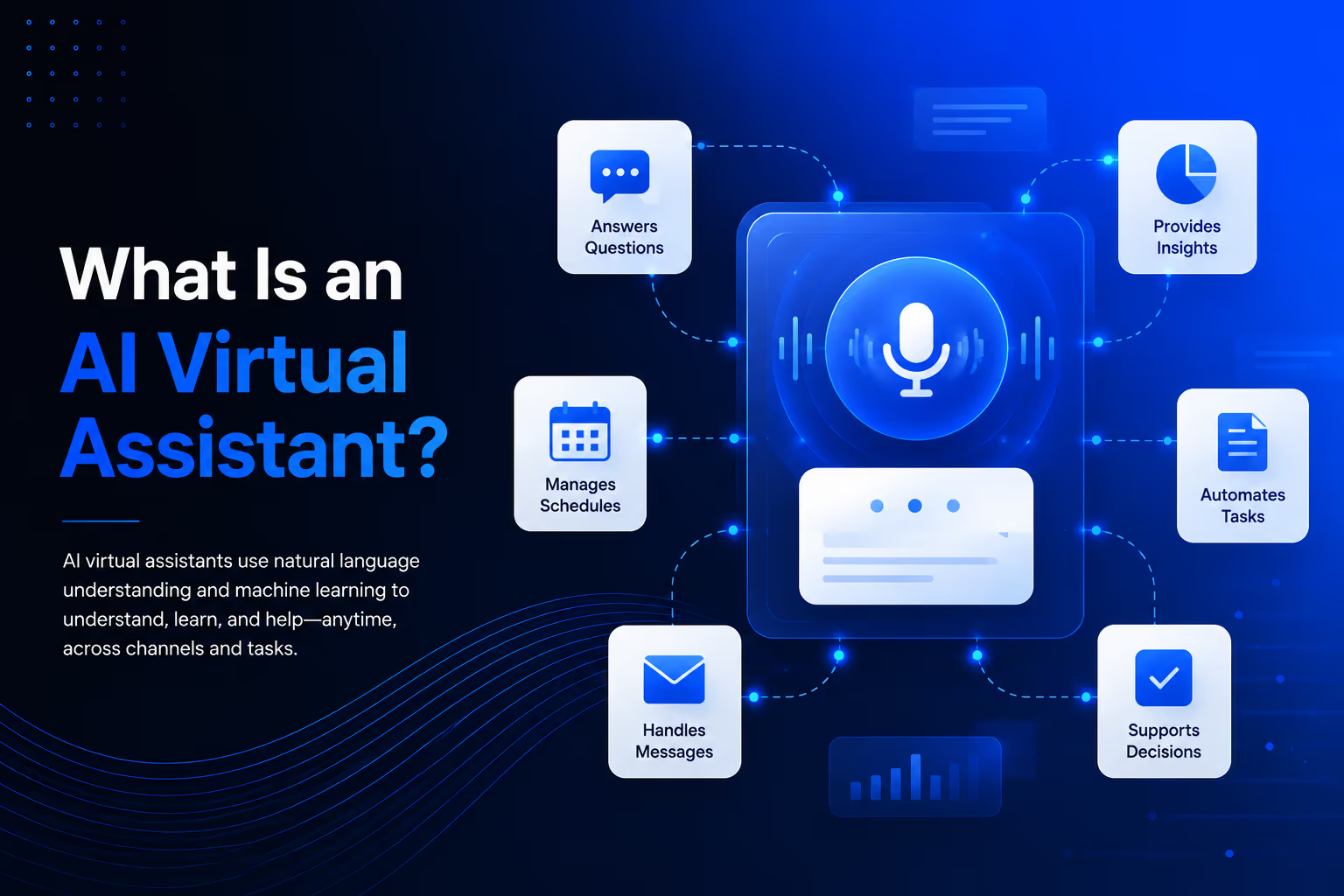
An AI virtual assistant is an intelligent software program that uses machine learning, natural language processing (NLP), and AI algorithms to assist users by performing tasks and services on their behalf.
These virtual assistants simulate human interaction, responding to voice or text inputs to manage tasks such as answering queries, scheduling appointments, and automating routine processes. What sets AI virtual assistants apart from traditional systems is their ability to learn from past interactions and continuously improve their responses.
AI virtual assistants are increasingly deployed in both personal and professional environments. They manage individual tasks like reminders, emails, and complex workflows in business operations.
Discover Callveriq AI Virtual Assistant
How Do AI Virtual Assistants Work?
An AI virtual assistant combines technologies like natural language processing (NLP), machine learning (ML), speech recognition, and workflow automation to understand customer requests and respond intelligently. Instead of following rigid scripts, it analyzes user intent, retrieves relevant information, and takes the appropriate action in real time.
A typical AI virtual assistant works in the following steps:
- Understands customer intent: It analyzes voice or text inputs to determine what the customer is asking, even when requests are phrased differently.
- Retrieves relevant information: The assistant pulls data from connected systems such as CRMs, knowledge bases, or business applications to provide accurate, personalized responses.
- Executes business workflows: Beyond answering questions, it can schedule appointments, qualify leads, update customer records, send reminders, process requests, or trigger follow-up actions automatically.
- Learns from interactions: Using machine learning, the AI virtual assistant continuously improves its responses by learning from previous conversations and customer behavior.
- Hands off to human agents when needed: For complex or sensitive conversations, it transfers the interaction to a live agent while sharing the complete conversation history, ensuring a smooth customer experience.
By combining these capabilities, an AI virtual assistant can manage thousands of customer conversations simultaneously while delivering fast, accurate, and personalized support across voice and digital channels.
Why Businesses Use AI Virtual Assistants
Modern businesses are expected to deliver fast, personalized customer experiences across every touchpoint. Whether responding to inquiries, qualifying leads, scheduling appointments, or resolving support requests, customers expect instant assistance regardless of the time or channel. Meeting these expectations with human teams alone can increase costs, create operational bottlenecks, and lead to inconsistent customer experiences.
This is why more organizations are investing in an AI virtual assistant. Instead of simply answering predefined questions, today's AI-powered solutions automate repetitive customer interactions, understand user intent, and take meaningful actions while keeping conversations natural and context-aware.
For businesses, an AI virtual assistant delivers measurable operational benefits by:
- Automating repetitive customer conversations, allowing teams to focus on high-value interactions.
- Providing 24/7 support so customers receive timely assistance even outside business hours.
- Qualifying leads automatically and routing high-intent prospects to sales teams.
- Reducing response and resolution times across voice, chat, and messaging channels.
- Scaling customer engagement without proportionally increasing headcount.
- Delivering consistent, personalized experiences that improve customer satisfaction and retention.
As customer journeys become increasingly omnichannel, businesses also need AI that can continue conversations across voice calls, WhatsApp, web chat, and live agents without losing context. Platforms like Callveriq enable organizations to deploy AI virtual assistants that qualify leads, answer customer queries, automate follow-ups, and seamlessly hand over conversations to human agents with the full conversation history, ensuring customers never have to repeat themselves.
Understanding why businesses are adopting an AI virtual assistant makes it easier to appreciate the technology behind it. Let's look at how AI virtual assistants understand customer intent, generate responses, and automate real-world conversations.
AI adoption is also moving beyond pilot projects. Salesforce's 2026 State of Service: AI Agents Edition found that 66% of customer service organizations have deployed AI agents, up from 39% the previous year. Among those organizations, 70% reported measurable business value within 60 days, with customer satisfaction emerging as the top improved KPI.
Automate customer conversations with Callveriq
This blog is just the start.
Unlock the power of Callveriq’s AI with a live demo.

Core Capabilities of an AI Virtual Assistant
An AI virtual assistant goes beyond answering customer questions. It combines conversational AI with business automation to understand intent, execute tasks, and deliver seamless experiences across multiple customer touchpoints. These core capabilities help businesses improve efficiency while providing faster, more personalized interactions at scale.
1. Task Automation and Efficiency
AI virtual assistants can automate repetitive tasks, such as in call centers. AI-powered assistants can handle routine tasks such as answering common customer questions, scheduling calls, and managing inquiries, all without human intervention, which reduces errors and improves overall efficiency.
With an AI virtual helper, businesses can manage large volumes of tasks simultaneously, ensuring smooth workflows and higher productivity. Whether automating data entry, appointment scheduling, or follow-up emails, AI-powered virtual assistants excel at optimizing time-consuming tasks.
2. Personalization and Adaptability
The ability of AI virtual assistants to personalize user experiences is a game-changer for both businesses and customers. These systems adapt to individual user preferences, learning from past interactions to provide more relevant and customized responses.
For example, an AI virtual assistant can tailor responses based on a customer’s previous interactions in customer service, offering more meaningful engagement.
Virtual assistant AI can also adjust its tone and language, adapting to the user’s communication style or geographic region. This level of personalization fosters better customer relationships, improving satisfaction and loyalty.
3. 24/7 Availability
Unlike human employees, AI virtual assistants can operate around the clock, providing 24/7 availability. This is especially crucial in customer service and support industries, where timely responses are key to customer satisfaction.
AI-powered virtual assistants ensure that no customer inquiry goes unanswered, even during non-business hours, weekends, or holidays. By providing continuous support, businesses can enhance their customer service experience, reduce response times, and improve overall engagement without increasing staffing costs.
4. Multilingual Support
As businesses expand globally, communication across languages becomes critical. AI-powered virtual assistants are equipped with multilingual capabilities, allowing them to seamlessly handle customer interactions in multiple languages. This feature especially benefits businesses operating across different regions, ensuring that language barriers do not impede customer service.
Virtual voice assistants can instantly switch between languages, facilitating better communication and ensuring customers receive assistance in their preferred language, making interactions more inclusive and accessible.
5. Seamless Integration
Another critical feature of AI virtual assistants is their ability to integrate with existing business tools and workflows. Whether it's connecting with customer relationship management (CRM) platforms, email systems, or scheduling tools, AI virtual assistants can be embedded into daily operations without causing disruption.
This seamless integration ensures that AI powered virtual assistants not only automate tasks but also collaborate effectively with other tools to enhance business efficiency.
For example, in a call center, an AI virtual assistant can retrieve customer information from the CRM, automate call follow-ups, and schedule future interactions all within one integrated system.
Experience AI Virtual Assistant Benefits
Virtual Assistant AI Examples Across Industries
Businesses across industries use an AI virtual assistant to automate repetitive conversations, improve customer experiences, and streamline operations. While the use cases vary by sector, the goal remains the same: deliver faster service, increase productivity, and enable teams to focus on higher-value interactions.
1. Business and Call Centers
In call centers, AI-powered virtual assistants transform how businesses handle customer inquiries and streamline communication. These assistants can manage high call volumes, route calls to the appropriate departments, and even automate outbound sales campaigns.
By reducing manual intervention, AI-powered virtual assistants ensure quicker response times and fewer human errors, improving customer satisfaction.
For example, a virtual voice assistant in a call center can assist with initial customer queries, freeing human agents to focus on complex issues. This improves the call center's efficiency, reduces customer waiting times, and ensures that human agents handle higher-value tasks.
2. Healthcare and Medical Services
AI virtual assistants are pivotal in enhancing patient care and operational efficiency in the healthcare sector. These assistants can schedule appointments, send medication reminders, and support health monitoring.
Patients can interact with the assistant to book appointments, get reminders for prescription refills, and receive timely updates about their health status. By automating these routine tasks, healthcare providers can focus more on direct patient care, improving the quality of care and operational efficiency.
3. E-commerce and Retail
In e-commerce, virtual assistants are increasingly used to guide customers through shopping. These assistants can provide personalized product recommendations, assist with order tracking, and answer customer queries, enhancing customer satisfaction and retention.
For instance, AI virtual assistants can analyze past purchase behavior to recommend relevant products, helping customers make faster decisions while increasing business sales.
Types of AI Virtual Assistant Software
Not all AI virtual assistants are built for the same purpose. Some help individuals manage everyday tasks, while others are designed to automate customer conversations, support employees, or accelerate business growth. Understanding the different types of AI virtual assistant software can help businesses choose the right solution for their needs.
1. Personal AI Virtual Assistants
Personal AI virtual assistants are designed to simplify daily activities for individual users. They can set reminders, schedule appointments, answer questions, play music, control smart home devices, and provide information through voice or text commands. Popular examples include Siri, Google Assistant, and Amazon Alexa. While these assistants improve personal productivity, they offer limited capabilities for managing enterprise customer interactions.
2. Customer Support AI Virtual Assistants
Customer support AI virtual assistants help businesses deliver faster, round-the-clock service across multiple communication channels. They answer frequently asked questions, track orders, resolve common issues, and escalate complex cases to human agents when required. By automating routine support requests, businesses can reduce wait times, improve customer satisfaction, and enable support teams to focus on more complex conversations.
3. AI Sales Virtual Assistants
An AI virtual assistant for sales helps businesses engage and qualify leads more efficiently. It can initiate conversations, collect customer information, answer product-related questions, schedule meetings, send follow-ups, and identify high-intent prospects before handing them over to sales representatives. This enables sales teams to spend more time closing opportunities instead of performing repetitive administrative tasks.
4. AI Phone Agents
AI phone agents are specialized AI virtual assistants built for voice conversations. They can handle inbound and outbound phone calls, verify customer information, qualify leads, book appointments, send payment reminders, conduct surveys, and transfer calls to live agents when necessary. Unlike traditional IVR systems, AI phone agents understand natural language, maintain conversational context, and deliver more human-like interactions.
5. AI Employee Assistants
AI employee assistants support internal business operations by helping employees quickly access company knowledge, complete routine workflows, retrieve documents, automate approvals, and answer HR or IT-related questions. These assistants improve workplace productivity while reducing the workload on internal support teams.
Which AI Virtual Assistant Is Right for Your Business?
The right AI virtual assistant depends on your business goals. Organizations focused on customer engagement typically need more than a standalone chatbot or voice assistant. They require a platform that can automate conversations across voice, chat, and messaging channels while integrating with existing CRM and business systems.
Callveriq brings these capabilities together through its AI-powered customer conversation platform. Businesses can deploy AI phone agents, AI chat agents, and AI WhatsApp agents to qualify leads, answer customer queries, automate follow-ups, and seamlessly transfer conversations to human agents with complete conversation context. This allows organizations to deliver consistent, personalized customer experiences while improving operational efficiency across the entire customer journey.
AI Virtual Assistant vs Chatbot vs AI Voice Agent
Businesses evaluating customer automation solutions often encounter terms like AI virtual assistant, chatbot, and AI voice agent. While these technologies are related, they serve different purposes. Understanding their capabilities helps organizations choose the right solution for their customer engagement strategy.
AI Virtual Assistant
An AI virtual assistant is the most comprehensive solution for businesses. It combines conversational AI, workflow automation, and business integrations to manage customer interactions across multiple channels. Beyond answering questions, it can qualify leads, schedule appointments, retrieve customer information, trigger business workflows, and hand conversations over to human agents with the full interaction history.
Chatbot
A chatbot is primarily designed for text-based conversations on websites or messaging platforms. It is effective for answering frequently asked questions, collecting basic information, and guiding users through predefined conversation flows. However, traditional chatbots often have limited contextual understanding and are not designed to manage complex, multi-channel customer journeys.
AI Voice Agent
An AI voice agent specializes in natural voice conversations over phone calls. It can answer inbound calls, make outbound calls, verify customer information, schedule appointments, send payment reminders, and support sales or collections campaigns. AI voice agents deliver human-like conversations but typically focus on voice interactions rather than managing the entire customer journey across channels.
How to Choose the Right AI Virtual Assistant
When evaluating an AI virtual assistant, look beyond basic automation. Choose a solution that offers:
- Omnichannel support across voice, chat, and messaging.
- CRM and business tool integrations for seamless workflows.
- Workflow automation for lead qualification, scheduling, and follow-ups.
- Analytics and reporting to measure performance and optimize conversations.
- Human handoff with context for complex customer interactions.
- Scalability and enterprise-grade security to support business growth.
Platforms like Callveriq combine these capabilities to help businesses automate customer conversations while delivering personalized, connected experiences across every channel.
Business Benefits of an AI Virtual Assistant
An AI virtual assistant does more than automate repetitive tasks. It helps businesses deliver faster, more consistent customer experiences while improving operational efficiency. By combining conversational AI with workflow automation, businesses can engage customers at scale without compromising on personalization.
1. Reduce Operational Costs
Handling repetitive customer queries, appointment scheduling, payment reminders, and lead qualification manually requires significant time and resources. An AI virtual assistant automates these routine interactions, allowing businesses to serve more customers while optimizing operational costs and enabling teams to focus on higher-value conversations.
2. Respond Faster Across Every Customer Channel
Customers expect immediate responses, whether they reach out through a phone call, WhatsApp, or live chat. An AI virtual assistant provides instant assistance, answers common questions, and captures customer intent in real time. Faster responses reduce customer wait times, improve engagement, and increase the likelihood of successful outcomes.
3. Convert More Leads with Timely Follow-ups
Speed plays a critical role in lead conversion. An AI virtual assistant engages prospects the moment they express interest, qualifies them based on predefined criteria, answers common questions, and schedules meetings or callbacks automatically. This ensures that promising leads receive timely attention while sales teams focus on closing opportunities.
4. Deliver Consistent Customer Experiences
Maintaining service quality across large teams can be challenging. An AI virtual assistant provides consistent responses, follows approved workflows, and maintains conversation context throughout the customer journey. Customers receive accurate information regardless of when or how they contact the business, creating a more reliable and trustworthy experience.
5. Improve Team Productivity
Sales and support teams spend a significant portion of their day on repetitive conversations that don't require human expertise. By automating routine customer interactions, an AI virtual assistant allows employees to focus on consultative selling, complex problem-solving, and relationship building, improving overall productivity.
6. Scale Customer Engagement Without Scaling Headcount
As customer inquiries grow, businesses often need to increase hiring to maintain service levels. An AI virtual assistant enables organizations to handle thousands of conversations simultaneously across multiple channels, making it easier to support business growth without proportionally increasing operational costs.
7. Create Seamless Omnichannel Customer Journeys
Today's customers move between voice calls, WhatsApp, web chat, and other digital channels before making a decision. An AI virtual assistant helps businesses maintain context across these interactions, ensuring customers don't have to repeat information and that every conversation continues seamlessly from where the last one ended.
Businesses looking to automate customer conversations at scale often choose platforms like Callveriq, which combine AI phone agents, AI WhatsApp agents, and AI chat agents into a unified platform. This allows organizations to qualify leads, automate follow-ups, route customers to the right channel, and hand over conversations to human agents with complete context, creating a more connected customer experience.
How Callveriq Helps Businesses Deploy AI Virtual Assistants
While general AI virtual assistants like Google Assistant, Cortana, Alexa, and Watson provide broad capabilities, Callveriq’s AI Phone Call is uniquely tailored for call center environments. It automates high-volume customer interactions, integrates seamlessly with CRM systems, and offers multilingual capabilities, making it the top choice for businesses looking to optimize customer service operations.
Callveriq’s AI Phone Call stands out among the best virtual assistant software by delivering efficient, scalable solutions to call centers. By automating routine tasks, Callveriq ensures that call centers remain productive and that customer interactions are handled quickly and accurately.
Wrapping Up: How to Select the Best AI Virtual Assistant Software
AI virtual assistants have rapidly become essential tools for businesses and individuals, offering enhanced productivity, personalized services, and improved operational efficiency. Whether managing a busy call center or looking for ways to automate personal tasks, an AI powered virtual assistant can offer tailored solutions to meet your needs.
If you're ready to take your call center operations to the next level, explore Callveriq’s AI Phone Call, a state-of-the-art virtual agent that automates customer engagement, reduces operational costs, and enhances the overall customer experience. Book a demo today to see how Callveriq can revolutionize your business.
AI is changing how service teams work, not replacing them. Gartner predicts that by 2029, agentic AI will autonomously resolve 80% of common customer service issues, potentially reducing operational costs by 30%, while enabling human agents to focus on higher-value interactions.
Book Callveriq’s AI Virtual Assistant Demo
FAQs
1. What is an AI virtual assistant?
An AI virtual assistant uses AI and NLP to understand voice or text commands and perform tasks like answering questions or providing assistance.
2. What can an AI assistant do?
An AI assistant answers questions, automates tasks, schedules appointments, manages emails, and provides 24/7 customer support.
3. What exactly does a virtual assistant do?
A virtual assistant handles routine tasks like scheduling, reminders, customer inquiries, and workflow automation to improve efficiency.
4. What is the virtual assistant AI model?
A virtual assistant AI model uses NLP and machine learning to understand user intent, generate responses, and improve over time.
5. What are the benefits of an AI assistant?
AI assistants boost productivity, automate repetitive tasks, provide 24/7 support, and improve efficiency while saving time.